Arms and Armour
Battle of Guillemont
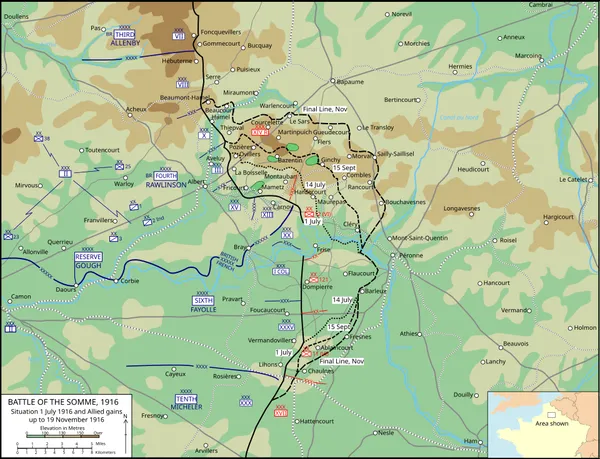
The Battle of Guillemont (3–6 September 1916) was an attack, during the Battle of the Somme in the First World War, by the British Fourth Army against the German 2nd Army near the village of Guillemont in northern France. The village is on the D 20 running east to Combles and the D 64 south-west to Montauban. Longueval and Delville Wood lie to the north-west and Ginchy to the north-east. The village was on the right flank of the British sector, near the boundary with the French Sixth Army. The Fourth Army had advanced close to Guillemont during the Battle of Bazentin Ridge (14–17 July) and the capture of the village was the culmination of British attacks which began on the night of 22/23 July. The attacks were intended to advance the right flank of the Fourth Army and eliminate a salient further north at Delville Wood. German defences ringed the wood and had observation over the French Sixth Army area to the south, towards the Somme river. Preparatory to a general attack intended for mid-September, from the Somme north to Courcelette (beyond the Albert–Bapaume road), the French Sixth Army, the Fourth Army and the Reserve Army conducted numerous attacks to capture the rest of the German second line and to gain observation over the German third line. The German defences around Guillemont were based on the remaining parts of the second line and fortified villages and farms northwards from Hem, Maurepas and Combles, to Falfemont Farm, Guillemont, Ginchy, Delville Wood and High Wood, which commanded the ground in between. The Battles Nomenclature Committee report of May 1921, called British military operations on the Somme during the fighting for Guillemont, the Battle of Delville Wood (14 July – 3 September) by the Fourth Army and the Battle of Pozières (23 July – 3 September) by the Reserve Army and III Corps of the Fourth Army. Attempts were made by Joseph Joffre, the French supreme commander, Sir Douglas Haig, Ferdinand Foch and the army commanders Henry Rawlinson and Émile Fayolle to co-ordinate attacks, which failed due to the recovery of the German 2nd Army from the disorganisation caused by the defeats in early July, disagreements over tactics by Haig and Joffre in July and August and organisational constraints caused by congestion behind the front, roads and tracks obliterated by Anglo-French artillery-fire becoming swamps when it rained.
Also on this shelf
Attack dog.
Baku Fortress Wall.
See also
Uncatalogued shelfText from Wikipedia; plate via Wikimedia Commons. Text CC BY-SA 4.0; plate freely licensed (see Commons). Source record. Images and catalogue data are reproduced from open-access collections.