Arms and Armour
Battle of Le Transloy
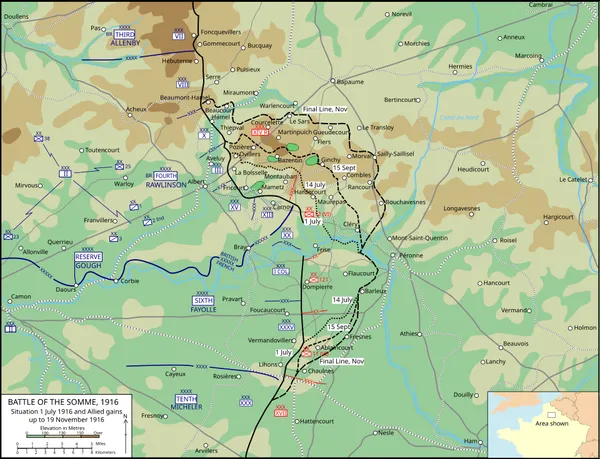
The Battle of Le Transloy was the last big attack by the Fourth Army of the British Expeditionary Force (BEF) in the 1916 Battle of the Somme in France, during the First World War. The battle was fought in conjunction with attacks by the French Tenth and Sixth armies on the southern flank and the Reserve/5th Army on the northern flank, against Army Group Rupprecht of Bavaria (Heeresgruppe Rupprecht) created on 28 August. General Ferdinand Foch, commander of groupe des armées du nord (GAN, Northern Army Group) and co-ordinator of the armies on the Somme, was unable to continue the sequential attacks of September because persistent rain, mist and fog grounded aircraft, turned the battlefield into a swamp and greatly increased the difficulty of transporting supplies to the front over the roads land devastated since 1 July. The German armies on the Somme managed a recovery after the string of defeats in September, with fresh divisions to replace exhausted troops and more aircraft, artillery and ammunition diverted from Verdun or stripped from other parts of the Western Front. Command of the German Air Service (Die Fliegertruppen) was centralised and the new Luftstreitkräfte (German Air Force) was able to challenge Anglo-French air superiority with the reinforcements and new, superior, fighter aircraft. The German flyers further reduced the ability of the Anglo-French airmen to support the armies with artillery-observation and contact patrols in the rare periods of clear weather. The German armies lost much less ground and had fewer casualties in October than in September but the proportion of casualties increased from 78.9 to 82.3 per cent of the Anglo-French total. Rain, fog and mud were lesser problems for the Germans, who had to carry supplies forward over a much narrower beaten zone and were being forced back onto undamaged ground. German bombardments on the few roads between the original front line and the line in October increased the difficulties of the British and French armies; the size and ambition of Anglo-French attacks was reduced progressively to local operations. Every soldier endured miserable conditions but the Germans knew that the onset of winter would end the battle, despite the many extra casualties caused by illness. The British and French outnumbered the Germans and could relieve divisions after shorter periods in the line.
Also on this shelf
Bushido.
Daugavgrīva castle.
See also
Uncatalogued shelfText from Wikipedia; plate via Wikimedia Commons. Text CC BY-SA 4.0; plate freely licensed (see Commons). Source record. Images and catalogue data are reproduced from open-access collections.