Arms and Armour
Dungan Revolt (1862–1877)
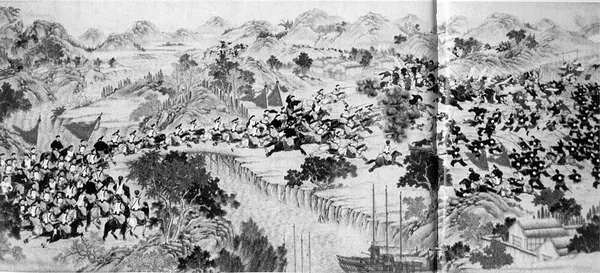
The Dungan Revolt (1862–1877), also known as the Tongzhi Hui Revolt (traditional Chinese: 同治回亂; simplified Chinese: 同治回乱; pinyin: Tóngzhì Huí Luàn, Xiao'erjing: تُجِ خُوِ لُوًا, Dungan: Тунҗы Хуэй Луан), was a war fought in 19th-century western China, mostly during the reign of the Tongzhi Emperor (r. 1861–1875) of the Qing dynasty. The term sometimes includes the Panthay Rebellion in Yunnan, which occurred during the same period. However, this article refers specifically to two waves of uprising by various Chinese Muslims, mostly Hui people, in Shaanxi, Gansu and Ningxia provinces in the first wave, and then in Xinjiang in the second wave, between 1862 and 1877. The uprising was eventually suppressed by Qing forces led by Zuo Zongtang. The conflict began with riots by the Hui and massacres of the Han Chinese, followed by the revenge massacres of the Hui by the Han. It resulted in massive demographic shifts in Northwest China, and led to a population loss of 21 million people from a combination of massacres, migration, famine, and corpse-transmitted plague. Due to the conflict, Gansu lost 74.5% (14.55 million) of its population, Shaanxi lost 44.6% (6.2 million) of its population, and Northern Xinjiang lost 72.6% (0.34 million) of its population. (However, one important matter to notice is that the casualties of the Dungan Revolt were suffered by both Han Chinese and Hui communities, but because Han Chinese constituted the majority of the regional population, they likely accounted for the larger share of total deaths in absolute numbers. However, Hui communities in some areas may have experienced a higher proportion of population loss relative to their own population size.) The population reduction of Hui in Shaanxi was particularly severe. According to research by modern historians, at least 4 million Hui were in Shaanxi before the revolt, but only 20,000 remained in the province afterwards, with most of the Hui either killed in massacres and reprisals by government and militia forces, or deported out of the province. Large numbers of Han people were also relocated to Inner Mongolia after the war.
Also on this shelf
Castle Fortress of Almeida.
Herschel C. Logan.
See also
Uncatalogued shelfText from Wikipedia; plate via Wikimedia Commons. Text CC BY-SA 4.0; plate freely licensed (see Commons). Source record. Images and catalogue data are reproduced from open-access collections.