Arms and Armour
Franco-Dutch War
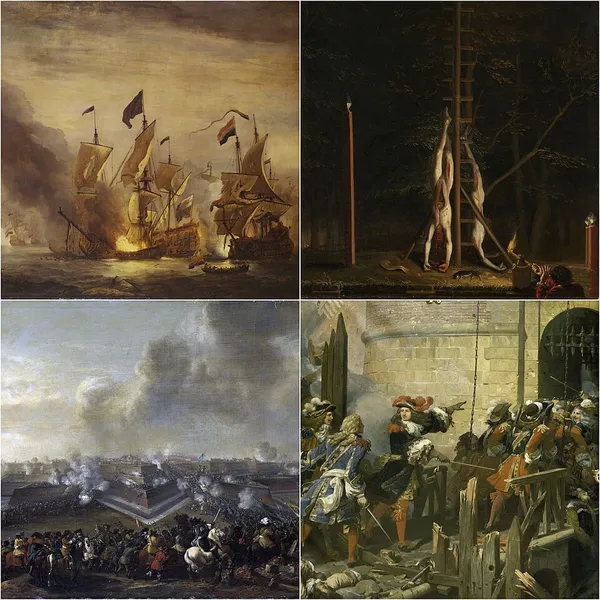
The Franco-Dutch War, 1672 to 1678, was primarily fought by France and the Dutch Republic, with both sides backed at different times by a variety of allies. Related conflicts include the Third Anglo-Dutch War of 1672 to 1674 and the Scanian War of 1675 to 1679. In May 1672, France nearly overran the Netherlands, an event remembered in Dutch history as the Rampjaar, or "Disaster Year". However, by late July the position had stabilised, while concern over French gains brought the Dutch support from Emperor Leopold I, Spain and Brandenburg-Prussia. Previously an ally of France, England exited the war in February 1674. Now facing a war of attrition on several fronts, Louis XIV of France instead focused on strengthening French borders with the Spanish Netherlands and Rhineland, while a coalition led by William of Orange sought to minimise any losses. By 1677, France had occupied Franche-Comté and made gains in the Spanish Netherlands and Alsace, but neither side was able to achieve a decisive victory. France failed to conquer the Dutch Republic; but the September 1678 Peace of Nijmegen is still often seen as the high point of French power in this period. Spain recovered Charleroi from France, but in return ceded Franche-Comté, as well as much of Artois and Hainaut. Under William of Orange, the Dutch regained all the territory lost at the beginning, making him dominant in domestic politics. This position helped him create the anti-French Grand Alliance that fought in the Nine Years' War (1688-1697), and the subsequent War of the Spanish Succession (1701-1714).
Also on this shelf
.45-70.
1st Battalion, Tower Hamlets Rifles.
See also
Uncatalogued shelfText from Wikipedia; plate via Wikimedia Commons. Text CC BY-SA 4.0; plate freely licensed (see Commons). Source record. Images and catalogue data are reproduced from open-access collections.