Arms and Armour
Border reivers
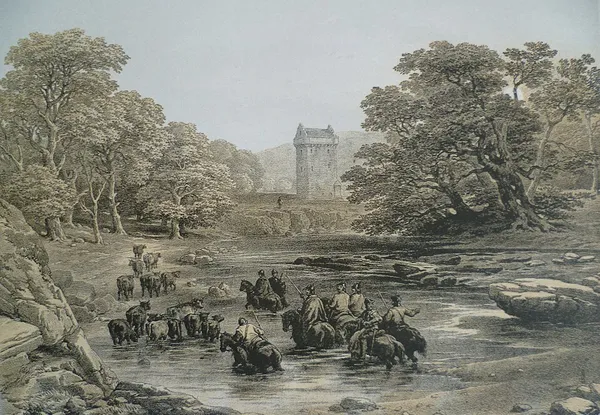
Border reivers were raiders along the Anglo-Scottish border. They included both English and Scottish people, and they raided the entire border country without regard to their victims' nationality. They operated in a culture of legalised raiding and feuding. Their heyday was in the last hundred years of their existence, during the time of the House of Stuart in the Kingdom of Scotland and the House of Tudor in the Kingdom of England. The historian G. M. Trevelyan summed up Border society by writing: Like the Homeric Greeks, the Borderers were cruel and barbarous men, slaying each other like beasts of the forest, but high in pride and honour and rough faithfulness. Amidst centuries of lawlessness, poverty and low-intensity conflict, compounded by significant invasions along the Anglo-Scottish frontier, familial groups gradually coalesced into organised units of common defence and offence based on kinship, giving rise to what would later be formalised as the 'Surnames.' The reivers emerged between 1350 and 1450, with their activities reaching their height in the 16th century during the Tudor period in England and the late Stewart period in Scotland. Reiving was a matter of subsistence for the borderer. They were infamous for raiding, blood feuds, eliciting protection money or taking hostages (blackmail), where justice was frequently negotiated through arbitration at Truce Days rather than enforced and mandated by state law. Often the dividing line between officially sanctioned raiding and independent raiding was not clear. Many crimes, such as theft and feuding, were treated with less severity due to the ancient customs and culture of the Borderlands, which had evolved over centuries to tolerate and codify such practices in the March law. Although less well-known than Highlanders in Scotland, whom they met and defeated in battle on occasion, the border reivers played a significant role in shaping Anglo-Scottish relations. Their activities were a major factor in ongoing tensions between the two kingdoms, and their raids often had international repercussions.
Also on this shelf
Amphibious warfare ship.
Fortifications of Messina.
See also
Uncatalogued shelfText from Wikipedia; plate via Wikimedia Commons. Text CC BY-SA 4.0; plate freely licensed (see Commons). Source record. Images and catalogue data are reproduced from open-access collections.