Arms and Armour
Battle of Pilckem Ridge
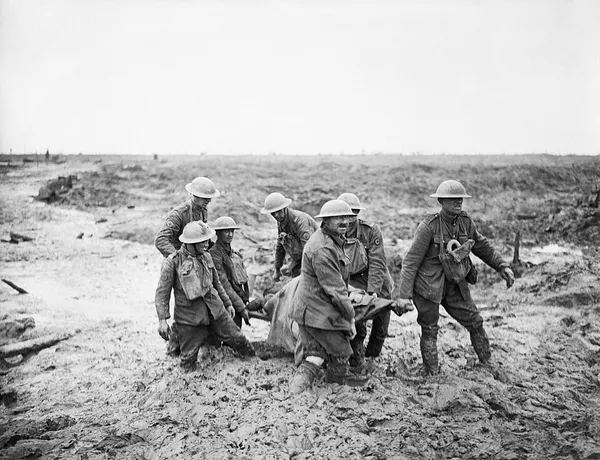
The Battle of Pilckem Ridge (31 July – 2 August 1917) was the opening attack of the Third Battle of Ypres in the First World War. The British Fifth Army, supported by the Second Army on the southern flank and the French 1reArmée (First Army) on the northern flank, attacked the German 4th Army, which defended the Western Front from Lille northwards to the Ypres Salient in Belgium and on to the North Sea coast. On 31 July, the Anglo-French armies captured Pilckem (Flemish: Pilkem) Ridge and areas on either side, the French attack being a great success. After several weeks of changeable weather, heavy rain fell during the afternoon of 31 July. In the XIX Corps area in the centre and on the right of XVIII Corps, three reserve brigades advanced from the black line to the main objective (green line) and pressed on towards the red line, the furthest that exploitation on local initiative had been allowed for in the plan. It began to rain, cutting off the advanced British troops from view, just as German regiments from specialist Eingreif (counter-attack) divisions advanced over Passchendaele Ridge. To avoid being rolled up, the reserve brigades retreated, suffering many casualties, through the green line to the black line, which the British artillery-observers could still see; the German infantry were prevented from advancing further by massed artillery and small-arms fire. A substantial amount of ground had been captured by the British and French, except on the Gheluvelt Plateau on the right flank, where only the blue line (first objective) and part of the black line (second objective) were captured. A large number of casualties were inflicted on the German defenders during the attack and 5,626 prisoners were taken; the German Eingreif divisions recaptured some ground from the Ypres–Roulers railway northwards to St Julien, forcing the British back to the black line. For the next few days, both sides made local attacks to improve their positions, much hampered by the deluges.
Also on this shelf
Citadel of Namur.
Igor of Kiev.
See also
Uncatalogued shelfText from Wikipedia; plate via Wikimedia Commons. Text CC BY-SA 4.0; plate freely licensed (see Commons). Source record. Images and catalogue data are reproduced from open-access collections.