Arms and Armour
Battle of Jutland
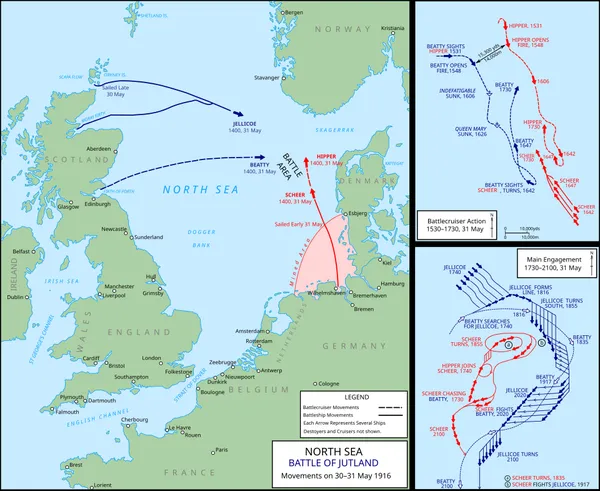
The Battle of Jutland (German: Skagerrakschlacht, lit. 'Battle of the Skagerrak') was a naval battle between Britain's Royal Navy Grand Fleet, under Admiral Sir John Jellicoe, and the Imperial German Navy's High Seas Fleet, under Vice-Admiral Reinhard Scheer, during the First World War. The battle unfolded in extensive manoeuvring and three main engagements from 31 May to 1 June 1916, off the North Sea coast of Denmark's Jutland Peninsula. It was the largest naval battle and only full-scale clash of battleships of the war. Jutland was also the last major naval battle, in any war, fought primarily by battleships. Germany's High Seas Fleet intended to lure out, trap, and destroy a portion of the British Grand Fleet. The German naval force was insufficient to openly engage the British fleet. This was part of a larger strategy to break the British blockade of Germany and allow German naval vessels access to the Atlantic. Britain's Royal Navy pursued a strategy of engaging and destroying the High Seas Fleet, thereby keeping German naval forces contained and away from Britain and her shipping lanes. The Germans planned to use Vice-Admiral Franz Hipper's fast scouting group of five modern battlecruisers to lure Vice-Admiral Sir David Beatty's battlecruiser squadrons into the path of the main German fleet. They stationed submarines across the likely routes of the British ships. However, the British learned from signal intercepts that a major fleet operation was likely, so on 30 May, Jellicoe sailed with the Grand Fleet to rendezvous with Beatty, passing over the German submarine picket lines while they were unprepared. The German plan had been delayed, causing further problems for their submarines, which had reached the limit of their endurance at sea. On the afternoon of 31 May, Beatty encountered Hipper's battlecruiser force earlier than the Germans had expected. Hipper successfully drew the British vanguard into the path of the High Seas Fleet. By the time Beatty sighted the larger force and turned back towards the British main fleet, he had lost two battlecruisers, from a force of six battlecruisers and four battleships. Beatty's withdrawal at the sight of the High Seas Fleet, which the British had not known was in the open sea, reversed the battle by drawing the Germans towards the British Grand Fleet.
Also on this shelf
15th (Scottish) Infantry Division.
Bratislava Castle.
See also
Uncatalogued shelfText from Wikipedia; plate via Wikimedia Commons. Text CC BY-SA 4.0; plate freely licensed (see Commons). Source record. Images and catalogue data are reproduced from open-access collections.