Arms and Armour
Macedonia (ancient kingdom)
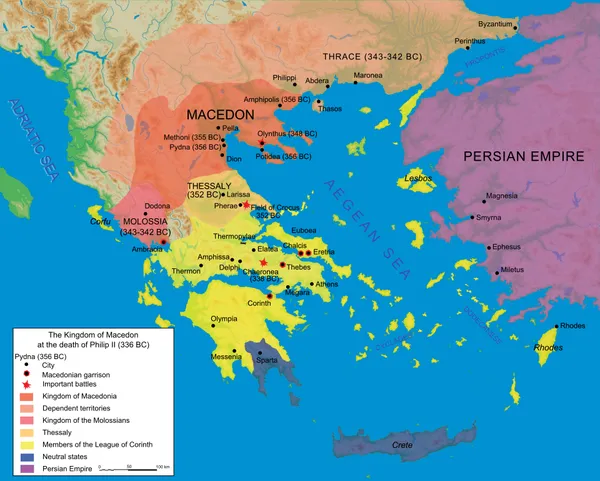
Macedonia ( MASS-ih-DOH-nee-ə; Greek: Μακεδονία, Makedonía), also called Macedon ( MASS-ih-don), was an ancient kingdom on the periphery of Archaic and Classical Greece, which later became the dominant state of Hellenistic Greece. The kingdom was founded and initially ruled by the royal Argead dynasty, which was followed by the Antipatrid and Antigonid dynasties. Home to the ancient Macedonians, the earliest kingdom was centred on the northeastern part of the Greek peninsula, and bordered by Epirus to the southwest, Illyria to the northwest, Paeonia to the north, Thrace to the east and Thessaly to the south. Before the 4th century BC, Macedonia was a small kingdom centered in Aegae, outside of the area dominated by the city-states of Athens, Sparta, and Thebes, and briefly subordinate to the Achaemenid Empire. During the reign of king Philip II (359–336 BC), Macedonia with its capital in Pella, subdued mainland Greece, Paeonia, and the Thracian Odrysian kingdom through conquest and diplomacy. With a reformed army containing phalanxes wielding the sarissa pike, Philip II defeated the old powers of Athens and Thebes at the Battle of Chaeronea in 338 BC. Philip II's son Alexander the Great, became king of Macedon and leader of the League of Corinth founded by his father, and accomplished the objective of commanding the whole of Greece when he destroyed Thebes when the city revolted. During Alexander's subsequent campaign of conquest, he overthrew the Achaemenid Empire and conquered territory that stretched as far as the Indus River. For a brief period, his Macedonian Empire was the most powerful in the world – the definitive Hellenistic state, inaugurating the transition to a new period of Ancient Greek civilization. Greek arts and literature flourished in the new conquered lands and advances in philosophy, engineering, and science spread across the empire and beyond. Of particular importance were the contributions of Aristotle, tutor to Alexander, whose writings became a keystone of Western philosophy. After Alexander's death in 323 BC, the ensuing wars of the Diadochi, and the partitioning of Alexander's short-lived empire, Macedonia remained a Greek cultural and political centre in the Mediterranean region along with Ptolemaic Egypt, the Seleucid Empire, and the Attalid kingdom.
Also on this shelf
Hoplite.
East Lancashire Royal Engineers.
See also
Uncatalogued shelfText from Wikipedia; plate via Wikimedia Commons. Text CC BY-SA 4.0; plate freely licensed (see Commons). Source record. Images and catalogue data are reproduced from open-access collections.