Arms and Armour
Great Moravia
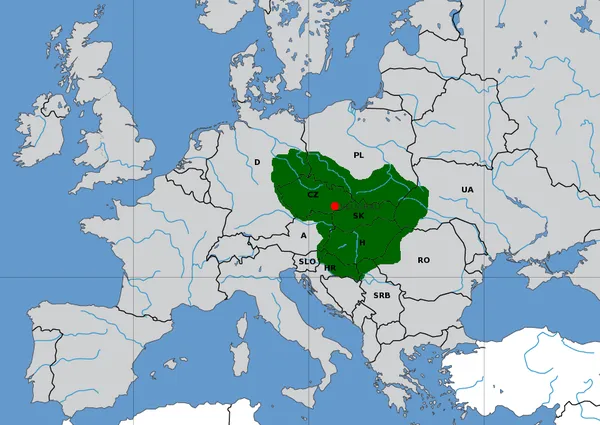
Great Moravia, or simply Moravia, was the first major state that was predominantly West Slavic to emerge in the area of Central Europe, possibly including territories which are today part of the Czech Republic, Slovakia, Hungary, Austria, Germany, Poland, Romania, Croatia, Serbia, Ukraine and Slovenia. The formations preceding it in these territories were Samo's tribal union (631–658) and the Pannonian Avar state (567–822). Centered on the Morava River – which gave the realm its name – the core encompassed today’s Moravia in the eastern Czech Republic and adjacent western Slovakia. The kingdom saw the rise of the first-ever Slavic literary culture in the Old Church Slavonic language as well as the expansion of Christianity, first via missionaries from East Francia, and later after the arrival of Saints Cyril and Methodius in 863 and the creation of the Glagolitic alphabet, the first alphabet dedicated to a Slavic language. Glagolitic was subsequently replaced by the Cyrillic alphabet created in the First Bulgarian Empire. Although the borders of this empire cannot be exactly determined, Moravia reached its largest territorial extent under Prince Svatopluk I (Slovak: Svätopluk), who ruled from 870 to 894. Separatism and internal conflicts emerging after Svatopluk's death contributed to the fall of Great Moravia, which was overrun by the Hungarians, who then included the territory of present-day Slovakia in their domains. The exact date of Moravia's collapse is unknown, but it occurred between 902 and 907. Moravia experienced significant cultural development under King Rastislav, with the arrival in 863 of the mission of Saints Cyril and Methodius. After his request for missionaries had been refused in Rome, Rastislav asked the Byzantine emperor to send a "teacher" (učiteľ) to introduce literacy and a legal system (pravьda) to Great Moravia. The request was granted. The missionary brothers Cyril and Methodius introduced a system of writing (the Glagolitic alphabet) and Slavonic liturgy, the latter eventually formally approved by Pope Adrian II. The Glagolitic script was probably invented by Cyril himself and the language he used for his translations of religious texts and his original literary creation was based on the Eastern South Slavic dialect he and his brother Methodius knew from their native Thessaloniki.
Also on this shelf
Attack dog.
Badajoz bastioned enclosure.
See also
Uncatalogued shelfText from Wikipedia; plate via Wikimedia Commons. Text CC BY-SA 4.0; plate freely licensed (see Commons). Source record. Images and catalogue data are reproduced from open-access collections.