Arms and Armour
Battle of Plassey
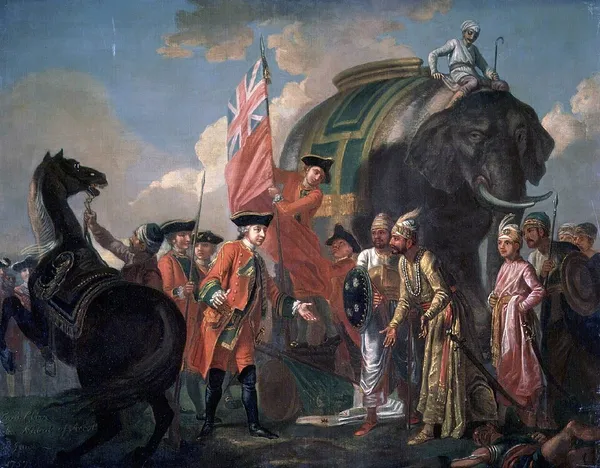
The Battle of Plassey was a decisive victory of the British East India Company, under the leadership of Robert Clive, over the Nawab of Bengal and his French allies on 23 June 1757. The victory was made possible by the betrayal of Mir Jafar, Nawab Siraj-ud-Daulah's commander in chief, as well as much of the Bengal Subah's armies being earlier committed against an Afghan invasion led by Ahmad Shah Durrani against the Mughal Empire. The battle helped the British East India Company take complete control of Bengal in 1773. Over the next hundred years, they continued to expand their control over vast territories in the rest of the Indian subcontinent and Burma. The battle took place at Palashi (Anglicised version: Plassey) on the banks of the Hooghly River, about 150 kilometres (93 mi) north of Calcutta (now Kolkata) and south of Murshidabad in West Bengal, then capital of Bengal State. The belligerents were the British East India Company and the Nawab Siraj-ud-Daulah, the last independent Nawab of Bengal. He succeeded Alivardi Khan (his maternal grandfather). Siraj-ud-Daulah had become the Nawab of Bengal the year before, and he had ordered the British to stop the extension of their fortification. Robert Clive bribed Mir Jafar, the commander-in-chief of the Nawab's army, and also promised to make him Nawab of Bengal. Clive defeated Siraj-ud-Daulah at Plassey in 1757 and captured Calcutta. The battle was preceded by an attack on British-controlled Calcutta by Nawab Siraj-ud-Daulah and the Black Hole massacre. The British sent reinforcements under Colonel Robert Clive and Admiral Charles Watson from Madras to Bengal and recaptured Calcutta. Clive then seized the initiative to capture the French fort of Chandannagar. Tensions and suspicions between Siraj-ud-daulah and the British culminated in the Battle of Plassey. The battle was waged during the Seven Years' War (1756–1763), and, in a mirror of their European rivalry, the French East India Company (La Compagnie des Indes Orientales) sent a small contingent to fight against the British. Siraj-ud-Daulah had a vast numerically superior force and made his stand at Plassey. The British, worried about being outnumbered, formed a conspiracy with Siraj-ud-Daulah's demoted army chief Mir Jafar, along with others such as Yar Lutuf Khan, Jagat Seths (Mahtab Chand and Swarup Chand), Umichand and Rai Durlabh.
Also on this shelf
Infantry.
Hellenistic armies.
See also
Uncatalogued shelfText from Wikipedia; plate via Wikimedia Commons. Text CC BY-SA 4.0; plate freely licensed (see Commons). Source record. Images and catalogue data are reproduced from open-access collections.