Arms and Armour
Brougham Castle
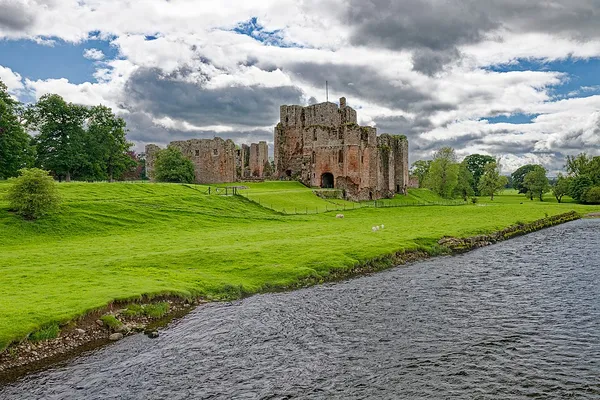
Brougham Castle (pronounced ) is a medieval building about 2 miles (3.2 km) south-east of Penrith, Cumbria, England. The castle was founded by Robert I de Vieuxpont in the early 13th century. The site, near the confluence of the rivers Eamont and Lowther, had been chosen by the Romans for a Roman fort called Brocavum. The castle, along with the fort, is a scheduled monument: "Brougham Roman fort and Brougham Castle". In its earliest form, the castle consisted of a stone keep, with an enclosure protected by an earthen bank and a wooden palisade. When the castle was built, Robert de Vieuxpont was one of the only lords in the region who were loyal to King John. The Vieuxponts were a powerful land-owning family in North West England, who also owned the castles of Appleby and Brough. In 1264, Robert de Vieuxpont's grandson, also named Robert, was declared a traitor, and his property was confiscated by Henry III. Brougham Castle and the other estates were eventually returned to the Vieuxpont family, and stayed in their possession until 1269, when the estates passed to the Clifford family through marriage. With the outbreak of the Wars of Scottish Independence, in 1296, Brougham became an important military base for Robert Clifford, 1st Baron de Clifford. He began refortifying the castle: the wooden outer defences were replaced with stronger, more impressive stone walls, and a large stone gatehouse was added. The importance of Brougham and Robert Clifford was such that, in 1300, he hosted King Edward I at the castle. Robert's son, Roger Clifford, was executed as a traitor, in 1322, and the family estates passed into the possession of King Edward II, although they were returned once his son Edward III became king. The region was often at risk from the Scots, and in 1388, the castle was captured and sacked. Following this, the Cliffords began spending more time at their other castles, particularly Skipton Castle in North Yorkshire. Brougham descended through several generations of Cliffords, intermittently serving as a residence. However, by 1592, it was in a state of disrepair, as George Clifford, 3rd Earl of Cumberland was spending more time in southern England due to his role as Queen's Champion. The castle was briefly restored in the early 17th century, to such an extent, that King James I of England was entertained there in 1617.
Also on this shelf
Demetrius I Poliorcetes.
Fortifications of Copenhagen (17th century).
See also
Uncatalogued shelfText from Wikipedia; plate via Wikimedia Commons. Text CC BY-SA 4.0; plate freely licensed (see Commons). Source record. Images and catalogue data are reproduced from open-access collections.