Arms and Armour
History of the Cyclades
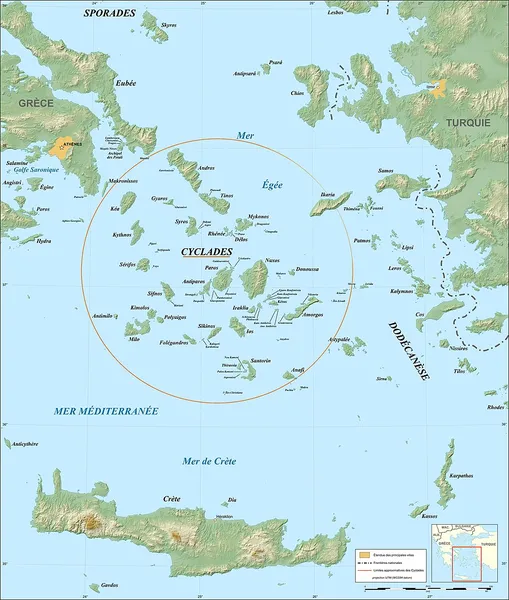
The Cyclades (Greek: Κυκλάδες Kykládes) are Greek islands located in the southern part of the Aegean Sea. The archipelago contains some 2,200 islands, islets and rocks; just 33 islands are inhabited. For the ancients, they formed a circle (κύκλος / kyklos in Greek) around the sacred island of Delos, hence the name of the archipelago. The best-known are, from north to south and from east to west: Andros, Tinos, Mykonos, Naxos, Amorgos, Syros, Paros and Antiparos, Ios, Santorini, Anafi, Kea, Kythnos, Serifos, Sifnos, Folegandros and Sikinos, Milos and Kimolos; to these can be added the little Cyclades: Irakleia, Schoinoussa, Koufonisi, Keros and Donoussa, as well as Makronisos between Kea and Attica, Gyaros, which lies before Andros, and Polyaigos to the east of Kimolos and Thirassia, before Santorini. At times they were also called by the generic name of the Archipelago. The islands are located at the crossroads of Europe, Asia Minor, and the Near East as well as between Europe and Africa. In antiquity, when navigation consisted only of cabotage and sailors sought never to lose sight of land, they played an essential role as a stopover. Into the 20th century, this situation made their fortune (trade was one of their chief activities) and their misfortune (control of the Cyclades allowed for control of the commercial and strategic routes in the Aegean). Numerous authors considered, or still consider, them as a unit. The insular group is indeed rather homogeneous from a geomorphological point of view; moreover, the islands are visible from one anothers' shores while being distinctly separate from the continents that surround them. They have in common a dry climate and soil. Although these physical facts are undeniable, other components of this unity are more subjective. Thus, one can read certain authors who say that the islands’ population is, of all the regions of Greece, the only original one, and has not been subjected to external admixtures. However, the Cyclades have very often known different destinies. Their natural resources and their potential role as trade-route stopovers has allowed them to be peopled since the Neolithic. Thanks to these assets, they experienced a brilliant cultural flowering in the 3rd millennium BC: the Cycladic civilisation. The proto-historical powers, the Minoans and then the Mycenaeans, made their influence known there.
Also on this shelf
John O'Meally.
Bregada.
See also
Uncatalogued shelfText from Wikipedia; plate via Wikimedia Commons. Text CC BY-SA 4.0; plate freely licensed (see Commons). Source record. Images and catalogue data are reproduced from open-access collections.