Arms and Armour
1323–1328 Flemish revolt
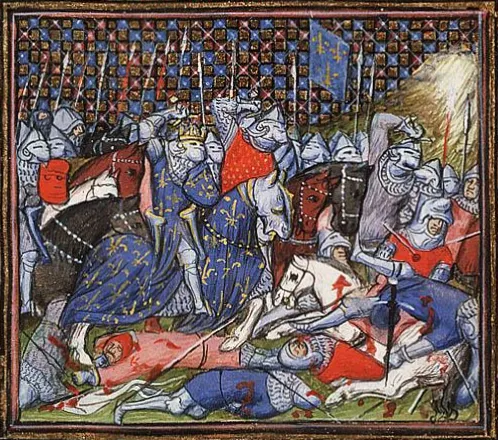
The Flemish peasant revolt of 1323–1328, sometimes referred to as the Flemish Coast uprising (Dutch: Opstand van Kust-Vlaanderen, French: soulèvement de la Flandre maritime) in historical writing, was a popular revolt in late medieval Europe. Beginning as a series of scattered rural riots in late 1323, peasant insurrection escalated into a full-scale rebellion that dominated public affairs in Flanders for nearly five years until 1328. The revolt in Flanders was caused by many of the working class being heavily taxed by the Count of Flanders Louis I and by his pro-French policies. The insurrection had urban leaders and rural factions, which took over most of Flanders by 1325. The revolt was led by Nicolaas Zannekin, a rich farmer from Lampernisse. Zannekin and his men captured the towns of Nieuwpoort, Veurne, Ypres and Kortrijk. In Kortrijk, Zannekin captured the count himself. In 1325, attempts to capture Ghent and Oudenaarde failed. The King of France, Charles IV, intervened. Louis was released from captivity in February 1326, and the Peace of Arques was sealed. The peace soon failed, and the count fled to France when more hostilities erupted. Louis convinced his new liege Philip VI of France to come to his aid, and Zannekin and his adherents were decisively defeated by the French royal army at the Battle of Cassel.
Also on this shelf
Bužim Fort.
AMX-13.
See also
Uncatalogued shelfText from Wikipedia; plate via Wikimedia Commons. Text CC BY-SA 4.0; plate freely licensed (see Commons). Source record. Images and catalogue data are reproduced from open-access collections.