Arms and Armour
Castle of Smar Jbeil
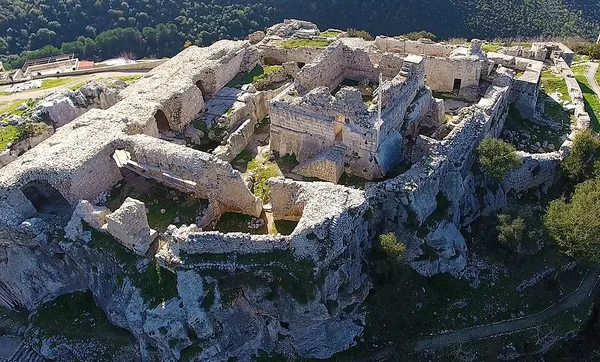
The castle of Smar Jbeil is a medieval stronghold located in the village of Smar Jbeil in the Batroun district of Lebanon, which is situated on a rocky promontory overlooking Nahr al-Madfoun (Madfoun River). It is a small tower-and-bailey castle with a rock-cut ditch, built during the Crusader period and serving as a feudal stronghold within the County of Tripoli. Constructed in three phases during the twelfth century by the Franks, the castle is surrounded by curtain walls, four corner towers, two mid-wall towers, and a barbican defending its entrance. Within its walls stood a range of interior structures, including a central donjon tower set on a bedrock podium, a chapel, a great hall, a stable, and storerooms.The castle likely belonged to a knight rewarded with the surrounding land as a fief, likely in recognition of service to the County of Tripoli's ruler. Its strategic position afforded views of the Mediterranean, the Mount Lebanon range, and the surrounding districts of Batroun and Jbeil. No contemporary Crusader-period records mention the castle, and its Latin name has not been identified. Surveys at the site have revealed evidence of earlier occupation spanning the Bronze Age and Roman periods, including a necropolis, funerary bas-reliefs, and rock-cut cisterns that predate the Crusader fortifications. The County of Tripoli fell to the Mamluk Sultanate in 1289, as the Mamluks swept across the Lebanese coast, capturing Batroun and its surrounding settlements. They destroyed the fortresses and fortifications they seized, causing most to be abandoned. By 1619, the castle was held by men loyal to the Sayfa family; that year, the Ottoman-era Druze Emir Fakhr al-Din II secured their defection during his conflict with the Sayfas, bringing the castle under his control, after which the Khazin family established their residence there. An earthquake in 1630 caused significant damage to the donjon and a lower vault; the castle was subsequently restored in 1631. During the nineteenth century, it served as the seat of the Maronite bishopric. The donjon tower remained the property of the Maronite Church until its expropriation by the Lebanese Directorate General of Antiquities in 1997. The castle is managed as an un-ticketed heritage site and is open to the public free of charge.
Also on this shelf
Battle of Castillon.
Battle of Poitiers.
See also
Uncatalogued shelfText from Wikipedia; plate via Wikimedia Commons. Text CC BY-SA 4.0; plate freely licensed (see Commons). Source record. Images and catalogue data are reproduced from open-access collections.