Arms and Armour
History of military logistics
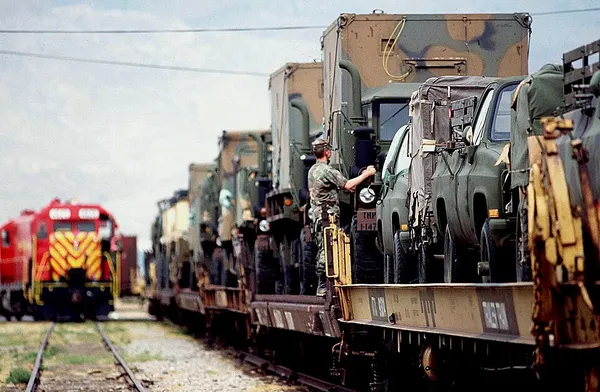
The history of military logistics goes back to Neolithic times. The most basic requirements of an army are food and water. Early armies were equipped with weapons used for hunting like spears, knives, axes and bows and arrows, and were small due to the practical difficulty of supplying a large number of soldiers. Large armies began to appear in the Iron Age. Animals such as horses, oxen, camels and even elephants were used to carry supplies. Food, water and fodder for the animals could usually be found or purchased in the field. The Roman Empire and Maurya Empire in India built networks of roads, but it was far less expensive to transport by sea than by road. After the fall of the Western Roman Empire in the fifth century there was a shift in Western Europe away from a centrally organised army. Starting in the late sixteenth century, armies in Europe increased in size, to 100,000 or more in some cases. When operating in enemy territory an army was forced to plunder the local countryside for supplies, which allowed war to be conducted at the enemy's expense. However, with the increase in army sizes, this reliance on pillage and plunder became problematic, as decisions regarding where and when an army could move or fight became based not on strategic objectives but on whether a given area was capable of supporting the soldiers' needs. Sieges in particular were affected by this, both for an army attempting to lay siege to a town and one coming to its relief. Unless a commander was able to arrange a form of regular resupply, a fortress or town with a devastated countryside could become immune to either operation. Napoleon made logistics a major part of his strategy. He dispersed his corps along a broad front to maximise the area from which supplies could be drawn. Each day forage parties brought in supplies. This differed from earlier operations living off the land in the size of the forces involved, and because the primary motivation was the emperor's desire for mobility. Ammunition could not as a rule be obtained locally, but it was still possible to carry sufficient ammunition for an entire campaign. The nineteenth century saw technological developments that facilitated immense improvements to the storage, handling and transportation of supplies which made it easier to support an army from the rear.
Also on this shelf
42 cm Gamma howitzer.
Chyhyryn.
See also
Uncatalogued shelfText from Wikipedia; plate via Wikimedia Commons. Text CC BY-SA 4.0; plate freely licensed (see Commons). Source record. Images and catalogue data are reproduced from open-access collections.