Arms and Armour
Battle of Hastings
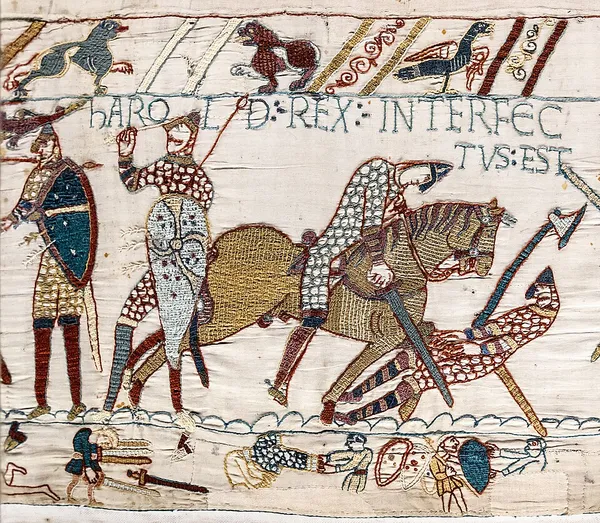
The Battle of Hastings was fought on 14 October 1066 between the Norman-French army of William, Duke of Normandy, and an English army under the Anglo-Saxon King Harold Godwinson, beginning the Norman Conquest of England. It took place approximately 7 mi (11 km) northwest of Hastings, close to the present-day town of Battle, East Sussex, and was a decisive Norman victory. The background to the battle was the death of the childless King Edward the Confessor in January 1066, which set up a succession struggle among several claimants to his throne. Harold was crowned king shortly after Edward's death, but faced invasions by William, his own brother Tostig, and the Norwegian king Harald Hardrada (Harold III of Norway). Hardrada and Tostig defeated a hastily gathered army of Englishmen at the Battle of Fulford on 20 September 1066. They were in turn defeated by Harold at the Battle of Stamford Bridge on 25 September. The deaths of Tostig and Hardrada at Stamford Bridge left William as Harold's only serious opponent. While Harold and his forces were recovering, William landed his invasion forces in the south of England at Pevensey on 28 September and established a beachhead for his conquest of the kingdom. Harold was forced to march south swiftly, gathering forces as he went. The numbers present at the battle are unknown, as even modern estimates vary considerably. The composition of the forces is clearer: the English army was composed almost entirely of infantry and had few archers, whereas only about half of the invading force was infantry, the rest split equally between cavalry and archers. Harold appears to have tried to surprise William, but scouts found his army and reported its arrival to William, who marched from Hastings to the battlefield to confront Harold. The battle lasted from about 9 am to dusk. Early efforts by the invaders to break the English battle lines had little effect. Therefore, the Normans adopted the tactic of pretending to flee in panic and then turning on their pursuers. Harold's death, probably near the end of the battle, led to the retreat and defeat of most of his army. After further marching and some skirmishing, William was crowned as king on Christmas Day 1066. There continued to be rebellions and resistance to William's rule, but Hastings effectively marked the culmination of William's conquest of England.
Also on this shelf
Battle of Kulikovo.
Fifth siege of Gibraltar.
See also
Uncatalogued shelfText from Wikipedia; plate via Wikimedia Commons. Text CC BY-SA 4.0; plate freely licensed (see Commons). Source record. Images and catalogue data are reproduced from open-access collections.