Arms and Armour
Fortress of Luxembourg
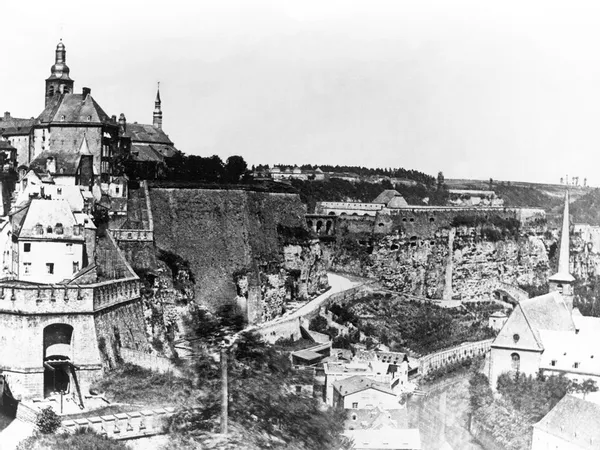
The Fortress of Luxembourg (Luxembourgish: Festung Lëtzebuerg; French: Forteresse de Luxembourg; German: Festung Luxemburg) is the former fortifications of Luxembourg City, the capital of the Grand Duchy of Luxembourg, which were mostly dismantled beginning in 1867. The fortress was of great strategic importance for the control of the Left Bank of the Rhine, the Low Countries, and the border area between France and Germany. The fortifications were built gradually over nine centuries, from soon after the city's foundation in the tenth century until 1867. By the end of the Renaissance, Luxembourg was already one of Europe's strongest fortresses, but it was the period of great construction in the 17th and 18th centuries that gave it its fearsome reputation. Due to its strategic location, it became caught up in Europe-wide conflicts between the major powers such as the Habsburg–Valois wars, the War of the Reunions, and the French Revolutionary Wars, and underwent changes in ownership, sieges, and major alterations, as each new occupier—the Burgundians, French, Austrian and Spanish Habsburgs, and Prussians—made their own improvements and additions. Luxembourg took pride in the flattering historical epithet of the "Gibraltar of the North" as a result of its alleged impregnability. By 1443 it had only been taken by surprise by Philip the Good. In 1795, the city, expecting imminent defeat and for fear of the following pillages and massacres, surrendered after a seven-month blockade and siege by the French, with most of its walls still unbreached. On this occasion, advocating to extend the revolutionary wars across the French borders, the French politician and engineer Lazare Carnot explained to the French National Convention that in taking Luxembourg, France had deprived its enemies of "... the best fortress in Europe after Gibraltar, and the most dangerous for France", which had put any French movement across the border at a risk. Thus, the surrender of Luxembourg made it possible for France to take control of the southern parts of the Low Countries and to annex them to her territory. The city's great significance for the frontier between the Second French Empire and the German Confederation led to the 1866 Luxembourg Crisis, almost resulting in a war between France and Prussia over possession of the German Confederation's main western fortress.
Also on this shelf
Australian frontier wars.
Combat reenactment.
See also
Uncatalogued shelfText from Wikipedia; plate via Wikimedia Commons. Text CC BY-SA 4.0; plate freely licensed (see Commons). Source record. Images and catalogue data are reproduced from open-access collections.