Arms and Armour
Axis capture of Tobruk
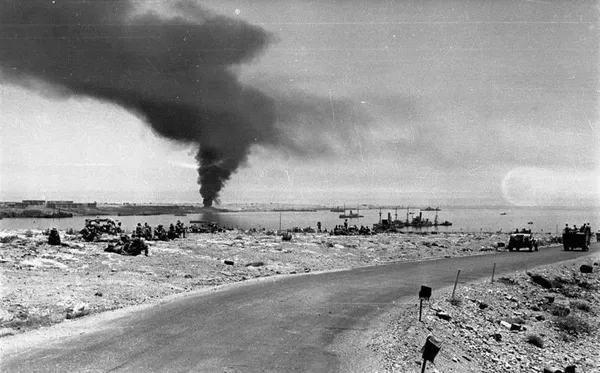
The Axis capture of Tobruk, also known as the Fall of Tobruk and the Second Battle of Tobruk (17–21 June 1942) was part of the Western Desert campaign in Libya during the Second World War. The battle was fought by the Panzerarmee Afrika (Armata Corazzata Africa in Italian), a German–Italian military force in North Africa which included the Afrika Korps (Generalleutnant Erwin Rommel), against the British Eighth Army (General Neil Ritchie) which comprised contingents from Britain, India, South Africa and other Allied nations. Axis forces had conducted the Siege of Tobruk for eight months in 1941 before its defenders, who had become an emblem of resistance, were relieved in December. Claude Auchinleck, the commander-in-chief Middle East Command, had decided not to defend Tobruk for a second time, due to the cost of bringing supplies in by sea; its minefields and barbed wire had been stripped for use in the Gazala Line to the west. By mid-1942 the Desert Air Force had been forced to move to airfields in Egypt, taking most of them beyond the range of Tobruk. About a third of all garrison personnel were non-combatant or support troops and many of the fighting troops were inexperienced. Lieutenant-General William Gott, the commander of XIII Corps, was withdrawn from Tobruk and on 15 June 1942, five days before the Axis attack. The new commander of the 2nd South African Division, Major-General Hendrik Klopper, was given command of the garrison. An immense stock of supplies had been accumulated around the port for Operation Acrobat but the Axis had forestalled this with Operation Venice (Unternehmen Venezia) and the Battle of Gazala began on 26 May 1942. The Eighth Army was defeated in the Battle of Gazala and was driven eastwards toward the Egyptian border, leaving Tobruk isolated. The Prime Minister, Winston Churchill, placed great store on the symbolic value of Tobruk; an exchange of ambiguous signals between Churchill and Auchinleck led to the garrison being surrounded, rather than evacuated as intended. On 20 June the Panzerarmee Afrika attacked Tobruk with massed air support, penetrated a weak spot on the eastern defensive perimeter and captured the port. Much of the garrison on the western perimeter had not been attacked but they were cut off from their supplies and transport, without the means to escape from Tobruk.
Also on this shelf
Fortifications of Copenhagen (17th century).
Battle of Steamroller Farm.
See also
Uncatalogued shelfText from Wikipedia; plate via Wikimedia Commons. Text CC BY-SA 4.0; plate freely licensed (see Commons). Source record. Images and catalogue data are reproduced from open-access collections.