Arms and Armour
Castra
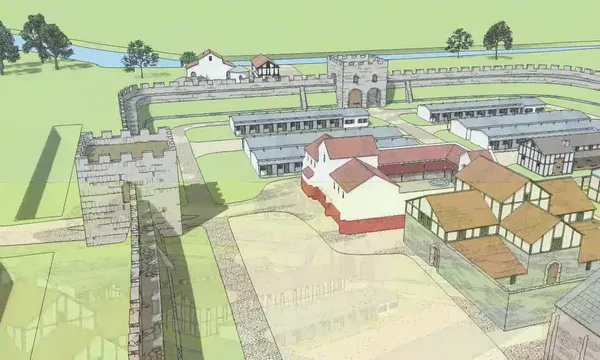
Castra (pl.) is a Latin term used during the Roman Republic and Roman Empire for a military 'camp', and castrum (sing.) for a 'fort'. In current English use, the peculiarity of the noun having different meanings in the singular and plural is sometimes less rigorously observed, given that both meanings indicate fortified positions used by the Roman army. A castrum was the fortified base of a Roman legion, a detachment thereof, or of auxiliary units, providing secure locations for training, administration, and defense. The army used a variety of fortified positions, both in size and function, ranging from temporary marching camps (castra aestiva) to large, permanent fortresses (castra stativa) that housed entire legions. They were typically designed with a standardized layout, including a rectangular plan, defensive walls, gates, and internal streets arranged in a grid pattern, reflecting Roman military discipline and engineering expertise. Permanent castra often became the foundations for towns and cities across the Roman Empire, many of which still bear traces of their Roman origins in their modern layouts and names. These fortifications played a crucial role in the expansion and maintenance of Roman power, enabling the army to project control over vast territories and respond quickly to threats.
Also on this shelf
Ahmad ibn Ibrahim al-Ghazi.
Grand Slam (bomb).
See also
Uncatalogued shelfText from Wikipedia; plate via Wikimedia Commons. Text CC BY-SA 4.0; plate freely licensed (see Commons). Source record. Images and catalogue data are reproduced from open-access collections.