Arms and Armour
Great Turkish War
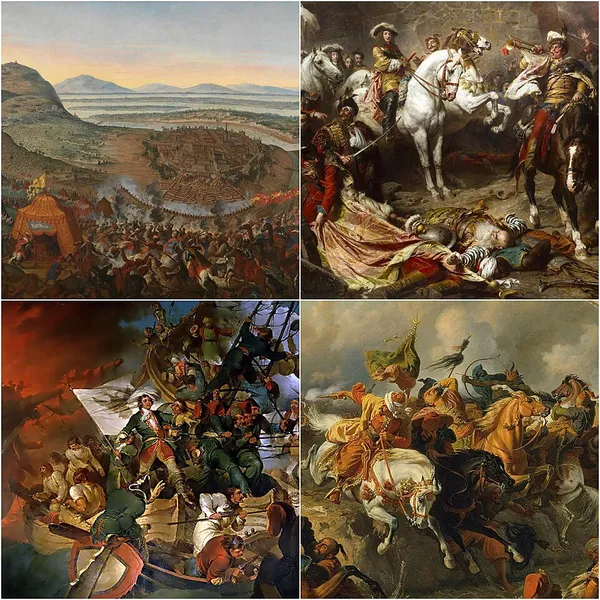
The Great Turkish War was a series of conflicts between the Ottoman Empire and the Holy League consisting of the Holy Roman Empire, Poland-Lithuania, Venice, Russia, and the Kingdom of Hungary. Intensive fighting began in 1683 and ended with the signing of the Treaty of Karlowitz in 1699. The war was a resounding defeat for the Ottoman Empire, which for the first time lost substantial territory, in Hungary and the Polish–Lithuanian Commonwealth, as well as in part of the western Balkans. The war was also the first instance of Russia joining an alliance with Western Europe. The French did not join the Holy League, as France had agreed to reviving an informal Franco-Ottoman alliance in 1673, in exchange for Louis XIV being recognized as a protector of Catholics in the Ottoman domains. Initially, Louis XIV took advantage of the conflict to extend France's eastern borders, seizing Luxembourg in the War of the Reunions, but deciding that it was unseemly to be fighting the Holy Roman Empire at the same time of its struggle with the Ottomans, he agreed to the Truce of Ratisbon in 1684. However, as the Holy League made gains against the Ottoman Empire, capturing Belgrade by 1688, the French began to worry that their Habsburg rivals would grow too powerful and eventually turn on France. Therefore, the French besieged Philippsburg on 27 September 1688, breaking the truce and triggering the separate Nine Years' War against the Grand Alliance, which included the Dutch Republic, the Holy Roman Empire and, after the Glorious Revolution, England as well. The war drew Imperial resources to the west and relieved the Turks. This was partially compensated by the entrance of Russia into the war in 1687. While the war started off with the Ottomans facing Imperial forces in the west, the Venetians to the south, and Poland-Lithuania to the north, which stretched Ottoman military resources across multiple fronts. As a result, they positioned about 60,000 men against the Holy Roman Empire, 37,000 against the Polish-Lithuanians, 35,000 against the Venetians, and a smaller force against Russians between 1684 and 1687. As a result, the advance made by the Holy League stalled, allowing the Ottomans to retake Belgrade in 1690.
Also on this shelf
Capture of Daugavgrīva.
Deva Victrix.
See also
Uncatalogued shelfText from Wikipedia; plate via Wikimedia Commons. Text CC BY-SA 4.0; plate freely licensed (see Commons). Source record. Images and catalogue data are reproduced from open-access collections.