Arms and Armour
Erich von Manstein
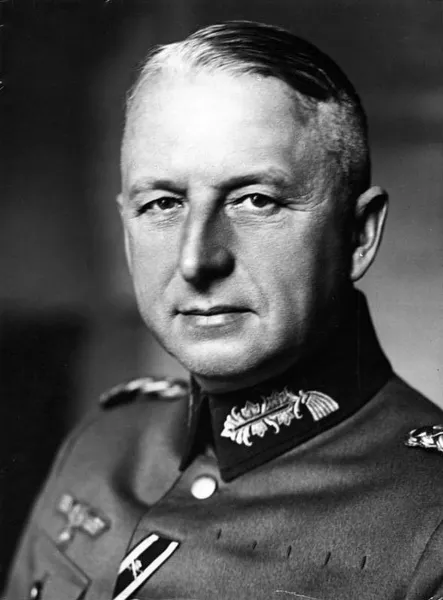
Erich von Manstein (born Fritz Erich Georg Eduard von Lewinski; 24 November 1887 – 10 June 1973) was a German military officer who served as a Generalfeldmarschall (Field marshal) in the Heer (Army) of Nazi Germany during World War II. He was subsequently convicted of war crimes and sentenced to 18 years imprisonment, but served fewer than four years before being released in 1953. Born into an aristocratic Prussian family with a long history of military service, Manstein joined the army at a young age and saw service on both the Western and Eastern Front during the First World War (1914–18). He rose to the rank of captain by the end of the war and was active in the inter-war period helping Germany rebuild its armed forces. In September 1939, during the invasion of Poland at the beginning of the Second World War, he served as Chief of Staff to Gerd von Rundstedt's Army Group South. Adolf Hitler chose Manstein's strategy for the invasion of France of May 1940. Anticipating a firm Allied reaction, should the main thrust of the invasion take place through the Netherlands, Manstein devised an innovative operation to invade France – later known as the Sichelschnitt ("sickle cut") – that called for an attack through the woods of the Ardennes and a rapid drive to the English Channel, thus cutting off the French and Allied armies in Belgium and Flanders. Attaining the rank of general at the end of the campaign, he was active in the invasion of the Soviet Union in June 1941. He led the Axis forces in the siege of Sevastopol (1941–1942) and the Battle of the Kerch Peninsula, and was promoted to field marshal on 1 July 1942, after which he participated in the siege of Leningrad. In December 1942, during the catastrophic Battle of Stalingrad, Manstein commanded a failed relief effort ("Operation Winter Storm"). Later known as the "backhand blow", Manstein's counteroffensive in the Third Battle of Kharkov (February–March 1943) regained substantial territory and resulted in the destruction of three Soviet armies and the retreat of three others. He was one of the primary commanders at the Battle of Kursk (July–August 1943). His ongoing disagreements with Hitler over the conduct of the war led to his dismissal in March 1944.
Also on this shelf
Caerlaverock Castle.
Hellenistic period.
See also
Uncatalogued shelfText from Wikipedia; plate via Wikimedia Commons. Text CC BY-SA 4.0; plate freely licensed (see Commons). Source record. Images and catalogue data are reproduced from open-access collections.