Arms and Armour
Cavalry
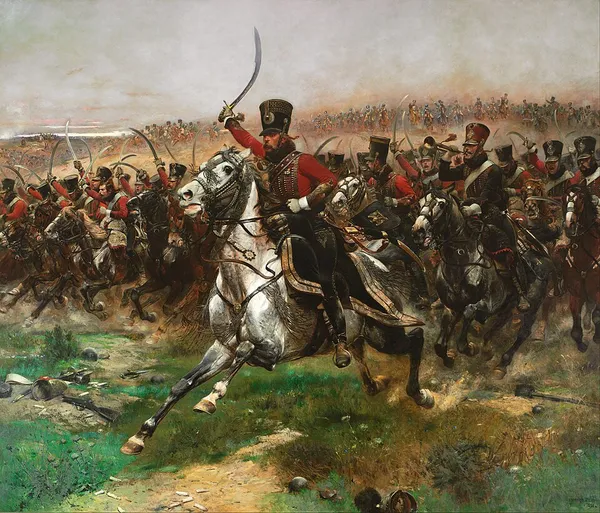
Cavalry (from the French word cavalerie, itself derived from cheval meaning "horse") are groups of soldiers or warriors who fight mounted on horseback. Until the 20th century, cavalry were the most mobile of the combat arms, operating as light cavalry in the roles of reconnaissance, screening, and skirmishing, or as heavy cavalry for decisive economy of force and shock attacks. An individual soldier in the cavalry is known by designations depending on era and tactics, such as a cavalryman, horseman, trooper, cataphract, knight, drabant, hussar, uhlan, mamluk, cuirassier, lancer, dragoon, samurai or horse archer. The designation of cavalry was not usually given to military forces that used other animals or platforms for mounts, such as chariots, camels or elephants. Infantry who moved on horseback, but dismounted to fight on foot, were known in the early 17th to the early 18th century as dragoons, a class of mounted infantry which in most armies later evolved into standard cavalry while retaining their historic designation. Cavalry had the advantage of improved mobility, and a soldier fighting from horseback also had the advantages of greater height, speed, and inertial mass over an opponent on foot. These aspects were greatly valued during the Ancient and Medieval eras. Some hosts were mostly cavalry, particularly in nomadic societies of Asia, such as the Huns of Attila and the later Mongol armies. In Europe, cavalry became increasingly armoured (heavy), evolving into the mounted knights of the medieval period. During the 17th century, cavalry in Europe discarded most of its armor, which was ineffective against the muskets and cannons that were coming into common use, and by the mid-18th century armor had mainly fallen into obsolescence, although some regiments retained a small thickened cuirass that offered protection against lances, sabres, and bayonets; including some protection against a shot from distance. In the interwar period, many cavalry units were converted into motorized infantry and mechanized infantry units, or reformed as tank troops. The cavalry tank or cruiser tank was one designed with a speed and purpose beyond that of infantry tanks and would subsequently develop into the main battle tank.
Also on this shelf
Battle of Newry Road.
Action of 22 October 1917.
See also
Uncatalogued shelfText from Wikipedia; plate via Wikimedia Commons. Text CC BY-SA 4.0; plate freely licensed (see Commons). Source record. Images and catalogue data are reproduced from open-access collections.