Arms and Armour
Capture of Mametz
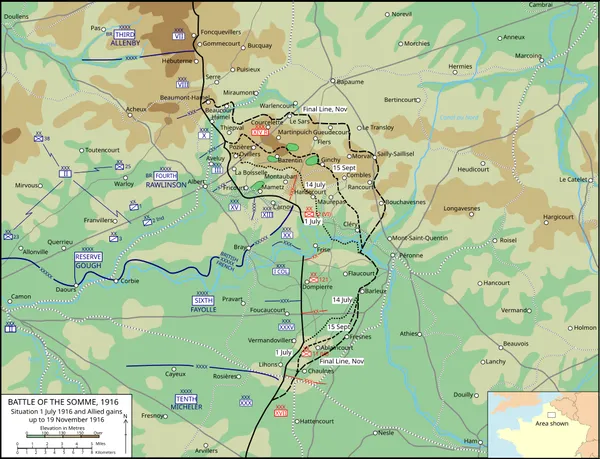
The Capture of Mametz took place on 1 July 1916, when the Fourth Army attacked the German 2nd Army on the Western Front, during the First day on the Somme. Mametz is a village on the D 64 road, about 20 mi (32 km) north-east of Amiens and 4 mi (6.4 km) east of Albert. Fricourt lies to the west, Contalmaison is to the north, Montauban to the north-east and Carnoy and Maricourt are to the south-east. Mametz Wood is 1,000 yd (910 m) to the north-west and before 1914, the village was the fifth largest in the area, with about 120 houses and a station on the line from Albert to Péronne. During the Battle of Albert (25 to 29 September 1914) the II Bavarian Corps attacked westwards north of the Somme but was fought to a standstill east of Mametz. Reinforced by the XIV Reserve Corps the Germans captured Mametz on 29 September. After a mutually-costly battle for Fricourt, the French were eventually forced out, the front line stabilised and both sides began to improvise defences. In mid-December a French in the Mametz area was a costly failure. Mine warfare began soon after a front line was established but the most extensive mining took place further north at La Boisselle. During 1915, the area around Mametz became a comparative backwater. The Germans began systematic fortification of the area, according to a directive from General Erich von Falkenhayn, head of Oberste Heeresleitung (supreme headquarters of the German army) to build defences on the Western Front that the fewest infantry could defend indefinitely. Later in the year work began on second and third defensive positions. On the Somme the defences north of the Bapaume–Albert were improved first and by July 1916 the defences of the first position around Mametz were extensive but the second position was a shallow trench and the third position had only been marked out. In June 1916 the British preliminary bombardment cut much of the barbed wire around Mametz and destroyed many trenches in the first position in the area of Reserve Infantry Regiment 109, 28th Reserve Division. When the 7th Division advanced behind a creeping barrage, much of the German front line was quickly overrun and many prisoners taken; delays further forward caused the infantry to lag behind the barrage and suffer far more casualties.
Also on this shelf
Frederick Barbarossa.
Battle of Komaki and Nagakute.
See also
Uncatalogued shelfText from Wikipedia; plate via Wikimedia Commons. Text CC BY-SA 4.0; plate freely licensed (see Commons). Source record. Images and catalogue data are reproduced from open-access collections.