Arms and Armour
Gold
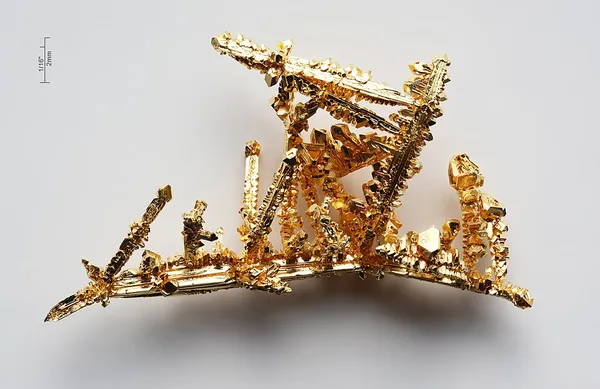
Gold is a chemical element; its chemical symbol is Au (from Latin aurum) and atomic number 79. In its pure form, it is a bright-metallic-yellow, dense, soft, malleable, and ductile metal. Chemically, gold is a transition metal, a group 11 element, and one of the noble metals. It is one of the least reactive chemical elements, being the second lowest in the reactivity series, with only platinum ranked as less reactive. Gold is solid under standard conditions. Gold often occurs as the free element (native state), as nuggets or grains, in rocks, veins, and alluvial deposits. It occurs in a solid solution series with the native element silver (as in electrum), naturally alloyed with other metals such as copper, platinum, and palladium, as well as mineral inclusions such as within pyrite. Less commonly, it occurs in minerals as gold compounds, often with tellurium (gold tellurides). Gold is resistant to most acids, though it does dissolve in aqua regia (a mixture of nitric acid and hydrochloric acid), forming a soluble tetrachloroaurate anion. Gold is insoluble in nitric acid alone, which dissolves silver and base metals, a property long used to refine gold and confirm the presence of gold in metallic substances, giving rise to the term "acid test". Gold dissolves in alkaline solutions of cyanide, which are used in mining and electroplating. Gold also dissolves in mercury, forming amalgam alloys, and as the gold acts simply as a solute, this is not a chemical reaction. A relatively rare element when compared to silver (though thirty times more common than platinum), gold is a precious metal that has been used for coinage, jewelry, and other works of art throughout recorded history. In the past, a gold standard was often implemented as a monetary policy. Most gold coins ceased to be minted as a circulating currency in the 1930s, and the world gold standard was abandoned for a fiat currency system after the Nixon shock measures of 1971. In 2023, the world's largest gold producer was China, followed by Russia and Australia. As of 2020, a total of around 201,296 tonnes of gold exist above ground. If all of this gold were put together into a cube shape, each of its sides would measure 21.7 meters (71 ft). The world's consumption of new gold produced is about 50% in jewelry, 40% in investments, and 10% in industry.
Also on this shelf
Crusades after the fall of Acre, 1291–1399.
Flagstaff War.
See also
Uncatalogued shelfText from Wikipedia; plate via Wikimedia Commons. Text CC BY-SA 4.0; plate freely licensed (see Commons). Source record. Images and catalogue data are reproduced from open-access collections.