Arms and Armour
Battle of Villers-Bocage
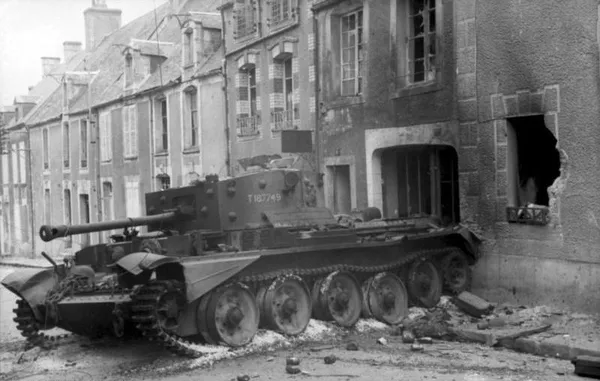
The Battle of Villers-Bocage took place during the Second World War on 13 June 1944, one week after the Normandy landings, which had begun the Western Allies' conquest of German-occupied France. The battle was the result of a British attempt to exploit a gap in the German defences west of the city of Caen. After one day of fighting in and around the small town of Villers-Bocage and a second day defending a position outside the town, the British force retreated. The Allies and the Germans regarded control of Caen as vital to the Normandy campaign. In the days following the D-Day landings on 6 June, the Germans rapidly dug in north of the city. On 9 June, a two-pronged British attempt to surround and capture Caen was defeated. On the right flank of the British Second Army, the 1st US Infantry Division had forced back the German 352nd Infantry Division and opened a gap in the German front. To bypass the German Panzer-Lehr Division blocking the direct route south in the area of Tilly-sur-Seulles, a mixed force of tanks, infantry and artillery, based on the 22nd Armoured Brigade (Brigadier William "Loony" Hinde) of the 7th Armoured Division, advanced through the gap in a flanking manoeuvre towards Villers-Bocage. British commanders hoped that the appearance of a strong force in their rear would surround the Panzer-Lehr Division or force it to withdraw. The 22nd Armoured Brigade group reached Villers-Bocage without serious incident on the morning of 13 June. The leading elements advanced eastwards from the town on the Caen road to a ridge at Point 213, where they were ambushed by Tiger I tanks of the 101st SS Heavy Panzer Battalion. In a few minutes, tanks, anti-tank guns and transport vehicles were destroyed, many by SS-Obersturmführer Michael Wittmann. The Germans attacked the town and were repulsed, losing several Tigers and Panzer IVs. After six hours, Hinde ordered a withdrawal to a more defensible position on a knoll west of Villers-Bocage. The next day, the Germans attacked the brigade box, arranged for all-round defence, in the Battle of the Island. The British inflicted a costly repulse on the Germans and then retired from the salient.
Also on this shelf
French Army.
Georg Günther Kräill von Bemeberg.
See also
Uncatalogued shelfText from Wikipedia; plate via Wikimedia Commons. Text CC BY-SA 4.0; plate freely licensed (see Commons). Source record. Images and catalogue data are reproduced from open-access collections.