Arms and Armour
Anglo-Saxon paganism
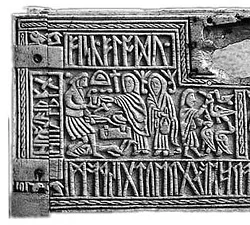
Anglo-Saxon paganism, sometimes termed Anglo-Saxon heathenism, Anglo-Saxon pre-Christian religion, Anglo-Saxon traditional religion, or Anglo-Saxon polytheism, is the set of religious beliefs and practices followed by the Anglo-Saxons between the 5th and 8th centuries AD, during the initial period of Early Medieval England. A variant of Germanic paganism found across much of north-western Europe, it encompassed a heterogeneous variety of beliefs and cultic practices, with much regional variation. Developing from the earlier Iron Age religion of continental northern Europe, it was introduced to Britain following the Anglo-Saxon migration in the mid 5th century, and remained the dominant belief system in England until the Christianisation of its kingdoms between the 7th and 8th centuries, with some aspects gradually blending into folklore. The pejorative terms paganism and heathenism were first applied to this religion by Christianised Anglo-Saxons, and it does not appear that the followers of the indigenous faith had a name for their religion themselves; there has therefore been debate among contemporary scholars as to the appropriateness of continuing to describe these belief systems using this Christian terminology. Contemporary knowledge of Anglo-Saxon paganism derives largely from three sources: textual evidence produced by Christian Anglo-Saxons like Bede and Aldhelm, place-name evidence, and archaeological evidence of cultic practices. Further suggestions regarding the nature of Anglo-Saxon paganism have been developed through comparisons with the better-attested pre-Christian belief systems of neighbouring peoples such as the Norse. Anglo-Saxon paganism was a polytheistic belief system, focused around a belief in deities known as the ése (singular ós). The most prominent of these deities was probably Woden; other prominent gods included Thunor and Tiw. There was also a belief in a variety of other supernatural entities which inhabited the landscape, including elves, nicors, and dragons. Cultic practice largely revolved around demonstrations of devotion, including sacrifice of inanimate objects and animals to these deities, particularly at certain religious festivals during the year. There is some evidence for the existence of timber temples, although other cultic spaces might have been open-air, and would have included cultic trees and megaliths.
Also on this shelf
Derg Castle.
Battle of Winnepang.
See also
Uncatalogued shelfText from Wikipedia; plate via Wikimedia Commons. Text CC BY-SA 4.0; plate freely licensed (see Commons). Source record. Images and catalogue data are reproduced from open-access collections.