Arms and Armour
Battle for Kneiphof
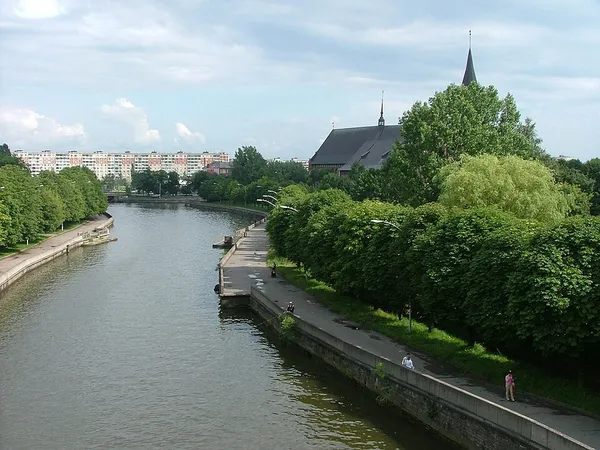
The Battle for Kneiphof (German: Belagerung des Kneiphofs) was the culmination of the struggle for control over the port district of Königsberg, Kneiphof, lasting from April 13 to July 14, 1455, during the Thirteen Years' War (1454–1466), ending with a decisive victory for the Teutonic Order. Königsberg actively participated in the anti-Teutonic uprising led by the Prussian Confederation in February 1454, capturing the Teutonic castle and being one of the four cities where the confederates paid homage to Casimir IV Jagiellon, voluntarily joining the Kingdom of Poland. The prolonged Thirteen Years' War and the increasing taxes associated with it resulted in a change in the political orientation of the common people and the pro-Teutonic uprising on 24 March 1455. As a result, the Old Town and Löbenicht districts returned to the control of the Teutonic Order, leaving only the port district of Kneiphof loyal to Casimir IV. Grand Master of the Order, Ludwig von Erlichshausen, directed forces led by the Grand Master Heinrich Reuß von Plauen against it, which, insufficient to carry out a direct assault, began the siege of the fortified district located on a river island on 13 April 1455. For 14 weeks, the garrison of Kneiphof, led by Mayor Jürgen Langerbein, defended the besieged district. Faced with insufficient assistance from the Prussian Confederation, led by Jan Bażyński, and the defeat of relief efforts by the Teutonic Knights, as well as the reinforcement of the besiegers by troops from Livonia and the Duchy of Żagań, they were forced to surrender on honorable terms on 14 July 1455 after the assault on 7 July 1455. Due to the strategic position of Königsberg at the mouth of the Pregolya river into the Vistula Lagoon, the Teutonic Order's recapture of control over the city resulted in it once again falling under the authority of the Grand Master of Samland, Lower Prussia, and Masuria, as well as the majority of urban centers in Warmia and Upper Prussia. As a result of the victorious battle, the Order also regained access to the Baltic Sea, the ability to engage in trade with Western Europe, and a foothold for further military operations.
Also on this shelf
Castle of Calendasco.
Ehrenfels Castle (Hesse).
See also
Uncatalogued shelfText from Wikipedia; plate via Wikimedia Commons. Text CC BY-SA 4.0; plate freely licensed (see Commons). Source record. Images and catalogue data are reproduced from open-access collections.