Arms and Armour
Badajoz bastioned enclosure
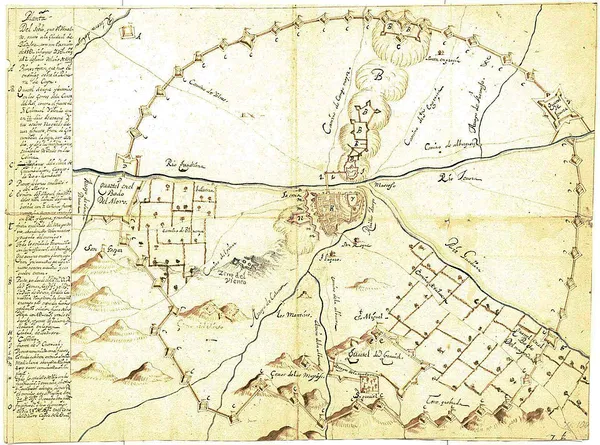
The bastioned system of the Spanish city of Badajoz consists of a military fortification formed by a set of defensive walls, city gates, bridges, forts, towers, bastions, hornworks, moats, tunnels, and ravelins, among other defensive elements. It was built during the 17th and 18th centuries, following the defensive construction theories popularized by the French military engineer Marquis de Vauban, as an extension of a previous defensive enclosure that protected the Portugal–Spain border city. From its founding by Ibn Marwan—over an earlier Visigothic settlement, as Badajoz has been inhabited since prehistoric times—the city maintained a stronghold character up to the 20th century. Its strategic location at the crossroads of two major routes: one from Castile to Andalusia, and the other to Lisbon, along with its status as a border city with Portugal, has led to both advantages for Badajoz's development and numerous conflicts involving various armies over the centuries. Consequently, the city has been protected by several defensive enclosures. The first fortifications were carried out by Ibn Marwan, who ordered the erection of mortar walls. This was followed by restoration work undertaken by Abd Allah Ibn Muhammad Ibn Abd al-Rahman, the founder's grandson, in 913 and by Abdallah ibn Al-Aftas, the first Aftasid king of the Taifa of Badajoz, in 1030. In 1169, the Alcazaba was built, closely resembling the present structure, with some elements dating back to the Almohad period. The final Muslim restoration was commissioned by Abu Yahya Ibn Abi Sinan at the beginning of the 13th century. After the conflicts between Castile and Portugal in the 14th century, relations between the two regions were normalized, leading to a period of peace that lasted nearly two and a half centuries. However, in 1640, when Portugal gained independence from the Spanish Monarchy, Badajoz became a border city. Due to its strategic importance, the Castilian authorities recognized the need to enhance its defenses. Consequently, both the Crown and the authorities of Badajoz decided to undertake significant fortification works. Despite the various options proposed by military engineers, the decision was made to implement the Vauban system.
Also on this shelf
Battle of Mogadishu (1993).
Heavy cavalry.
See also
Uncatalogued shelfText from Wikipedia; plate via Wikimedia Commons. Text CC BY-SA 4.0; plate freely licensed (see Commons). Source record. Images and catalogue data are reproduced from open-access collections.