Arms and Armour
Eighty Years' War, 1572–1576
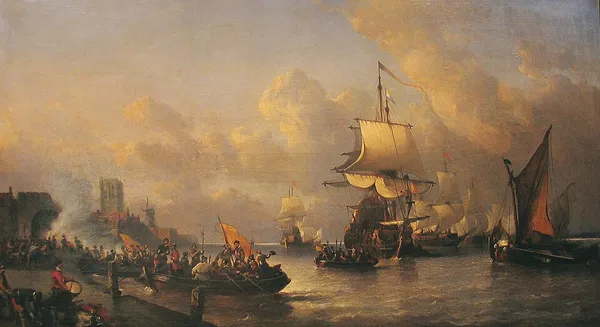
The period between the Capture of Brielle (1 April 1572) and the Pacification of Ghent (8 November 1576) was an early stage of the Eighty Years' War (c. 1568–1648) between the Spanish Empire and groups of rebels in the Habsburg Netherlands. After Watergeuzen (in English known as "Sea Beggars") seized several poorly defended towns and cities in Holland and Zeeland in April 1572, the exiled stadtholder William "the Silent" of Orange launched his second invasion of the Netherlands from the east in another attempt to generate a general uprising against the repressive regime of Spanish General-Governor Fernando Álvarez de Toledo, 3rd Duke of Alba. Acting on orders of Philip II of Spain, Alba sought to exterminate all manifestations of Protestantism and disobedience through inquisition and public executions, as well as abolishing several privileges of the Netherlandish nobility and autonomy of cities, and introducing more stringent taxes. William's second invasion in 1572 had mixed results, and Alba's son Don Fadrique went on a lightning campaign to retake all towns occupied by Orangist and Geuzen troops in October 1572. Several towns (including Mechelen, Zutphen and Naarden) which refused to surrender were brutally sacked by Fadrique's forces in an attempt to intimidate others into resubmitting themselves to the royal government, culminating in the seven-month-long Siege of Haarlem before it was conquered and sacked in July 1573. By this point, the rebel territory had been reduced to most towns in Holland (notably excluding royalist Amsterdam) and Zeeland, and two towns in Guelders; knowing that violent repression would result from resistance, these cities resolved to fight to the bitter end, while the others capitulated. The Spanish offensive stalled after Haarlem, with the Dutch rebels capturing Geertruidenberg, winning the Siege of Alkmaar and Battle of Delft, and achieving naval superiority. Citing ill health, Alba resigned and returned to Spain in December 1573. During Alba's governorship, the total number of people killed in the Netherlands by executions, burnings, and massacres is estimated to have reached 50,000. His successor Requesens was more conciliatory, but was unable to force or persuade many places back into governmental control, losing the Siege of Leiden (1573–1574).
Also on this shelf
Castle Batteries.
Heinkel He 111.
See also
Uncatalogued shelfText from Wikipedia; plate via Wikimedia Commons. Text CC BY-SA 4.0; plate freely licensed (see Commons). Source record. Images and catalogue data are reproduced from open-access collections.