Arms and Armour
Battle of Thermopylae
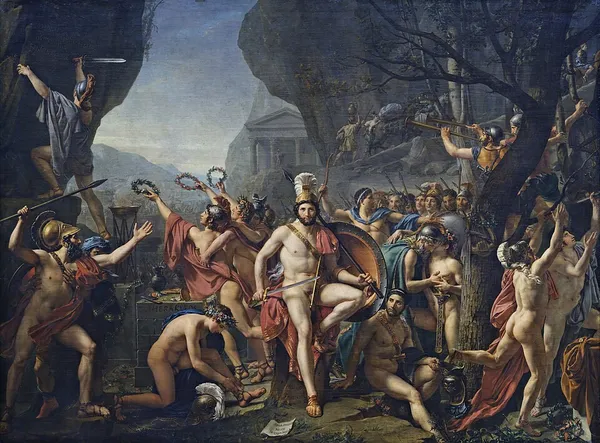
The Battle of Thermopylae () was fought in 480 BC at Thermopylae between the Achaemenid Persian Empire under Xerxes and an alliance of Greek city-states led by Sparta under Leonidas I. Lasting over the course of three days, it was one of the most prominent battles of both the second Persian invasion of Greece and the wider Greco-Persian Wars. The engagement occurred simultaneously with the naval Battle of Artemisium: between July and September during 480 BC. The second Persian invasion under Xerxes was a delayed response to the failure of the first Persian invasion, which had been initiated by Darius I and ended in 490 BC by an Athenian-led Greek victory at the Battle of Marathon. By 480 BC, a decade after the Persian defeat at Marathon, Xerxes had amassed a massive land and naval force, and subsequently set out to conquer all of Greece. In response, the Athenian politician and general Themistocles proposed that the allied Greeks block the advance of the Persian army at the pass of Thermopylae while simultaneously blocking the Persian navy at the Straits of Artemisium. Around the start of the invasion, a Greek force of approximately 7,000 men – including an estimated 300 Spartans – led by Leonidas marched north to block the pass of Thermopylae. Ancient authors vastly inflated the size of the Persian army, with estimates in the millions, but modern scholars estimate it at between 120,000 and 300,000 soldiers. They arrived at Thermopylae by late August or early September; the outnumbered Greeks held them off for seven days (including three of direct battle) before their rear-guard was annihilated in one of the most famous last stands in history. During two full days of battle, the Greeks blocked the only road by which the massive Persian army could traverse the narrow pass. After the second day, a local resident named Ephialtes revealed to the Persians the existence of a path leading behind the Greek lines. Subsequently, Leonidas, aware that his force was being outflanked by the Persians, dismissed the bulk of the Greek army and remained to guard their retreat along with 300 Spartans and 700 Thespians. It has been reported that others also remained, including up to 900 helots and 400 Thebans.
Also on this shelf
Dubno Castle.
Attack on Saint Martin.
See also
Uncatalogued shelfText from Wikipedia; plate via Wikimedia Commons. Text CC BY-SA 4.0; plate freely licensed (see Commons). Source record. Images and catalogue data are reproduced from open-access collections.