Arms and Armour
First Battle of Passchendaele
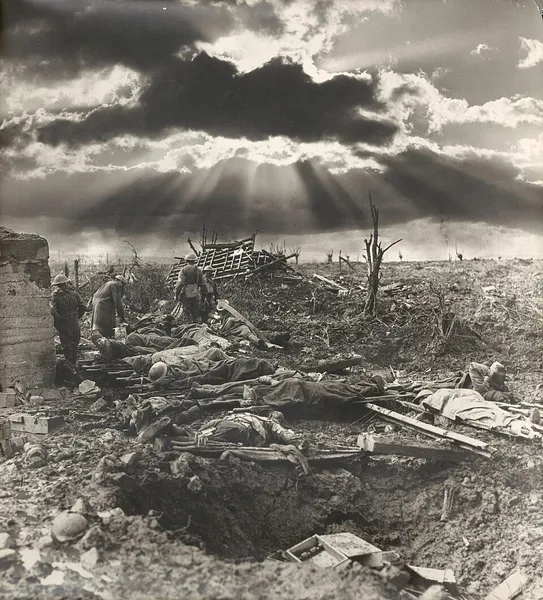
The First Battle of Passchendaele took place on 12 October 1917 during the First World War, in the Ypres Salient in Belgium on the Western Front. The attack was part of the Third Battle of Ypres and was fought west of Passchendaele village. The British had planned to capture the ridges south and east of the city of Ypres as part of a strategy decided by the Allies at conferences in November 1916 and May 1917. Passchendaele lay on the last ridge east of Ypres, 5 mi (8.0 km) from the railway junction at Roulers, which was an important part of the supply system of the German 4th Army. After a dry spell in September, rains began on 3 October and by the Battle of Poelcappelle on 9 October much of the British field artillery opposite Passchendaele was out of action due to rain, mud and German artillery-fire. The remaining guns were either left in old positions and fired at the limit of their range or were operated from any flat ground near wooden roadways or from platforms, many of which were unstable, where it was found impossible to move them forward. General Herbert Plumer and Field Marshal Douglas Haig were left under the impression that a big advance had been made towards Passchendaele ridge but most of the ground had been lost to German counter-attacks in the afternoon. The British attack on 12 October began 2,000–2,500 yd (1.1–1.4 mi; 1.8–2.3 km) from the village instead of the 1,500 yd (1,400 m) originally thought by the British commanders. Air reconnaissance revealed the true position too late to make substantial changes to the plan. The main attack of the Second Army was by the two Anzac Corps, supported by the Fifth Army to the north. On Passchendaele Ridge, opposite the I Anzac and II Anzac Corps, the attack was repulsed or captured ground was recovered by German counter-attacks. The attack on the right flank of the Fifth Army was a costly failure but on the left, the fringe of Houthoulst Forest was gained. British attacks were postponed until the weather improved and communications behind the front were restored. The battle was a German defensive success but was mutually costly and two German divisions were diverted to Flanders to replace "extraordinarily high" losses.
Also on this shelf
Deva Victrix.
Carreg Cennen Castle.
See also
Uncatalogued shelfText from Wikipedia; plate via Wikimedia Commons. Text CC BY-SA 4.0; plate freely licensed (see Commons). Source record. Images and catalogue data are reproduced from open-access collections.