Arms and Armour
Fourth Crusade
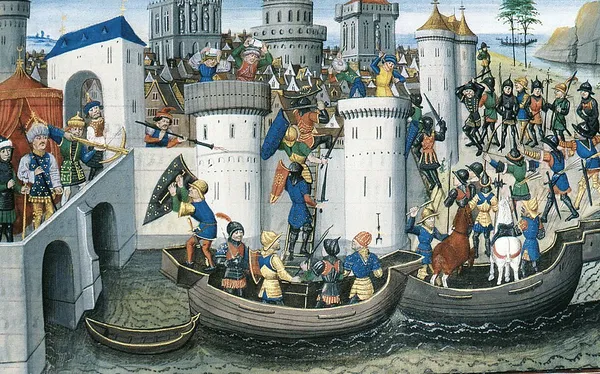
The Fourth Crusade (1202–1204) was a Latin Christian armed expedition called by Pope Innocent III. The stated intent of the expedition was to recapture the Muslim-controlled city of Jerusalem, by first defeating the powerful Egyptian Ayyubid Sultanate. However, a sequence of economic and political events culminated in the Crusader army's 1202 siege of Zara and the 1204 sack of Constantinople, rather than the conquest of Egypt as originally planned. This led to the partition of the Byzantine Empire by the Crusaders and their Venetian allies, leading to a period known as the Frankokratia ("Rule of the Franks" in Greek). In 1201, the Republic of Venice contracted with the Crusader leaders to build a dedicated fleet to transport their invasion force. However, the leaders greatly overestimated the number of soldiers who would embark from Venice, since many sailed from other ports, and the army that appeared could not pay the contracted price. In lieu of payment, the Venetian Doge Enrico Dandolo proposed that the Crusaders back him in attacking the rebellious city of Zara (Zadar) on the eastern Adriatic coast. This led in November 1202 to the sack of Zara, the first attack against a Catholic city by a Catholic Crusader army, despite Pope Innocent III's calls for the Crusaders not to attack fellow Christians. The city was then brought under Venetian control. When the Pope heard of this, he temporarily excommunicated the Crusader army. In January 1203, en route to Jerusalem, the Crusader leadership entered into an agreement with the Byzantine prince Alexios Angelos to divert their main force to Constantinople and restore his deposed father Isaac II Angelos as emperor, who would then add his support to their invasion of Jerusalem. On 23 June 1203, the main Crusader army reached Constantinople, while other contingents (perhaps a majority of all crusaders) continued to Acre. In August 1203, following the siege of Constantinople, Alexios was crowned co-emperor. However, in January 1204 he was deposed by a popular uprising, depriving the Crusaders of their promised bounty payments. Following the murder of Alexios on 8 February, the Crusaders decided on the outright conquest of the city. In April 1204, they captured and plundered the city's enormous wealth. Only a handful of the Crusaders continued to the Holy Land thereafter.
Also on this shelf
Euryalus fortress.
Cossack with musket.
See also
Uncatalogued shelfText from Wikipedia; plate via Wikimedia Commons. Text CC BY-SA 4.0; plate freely licensed (see Commons). Source record. Images and catalogue data are reproduced from open-access collections.