Arms and Armour
Heinkel He 162 Volksjäger
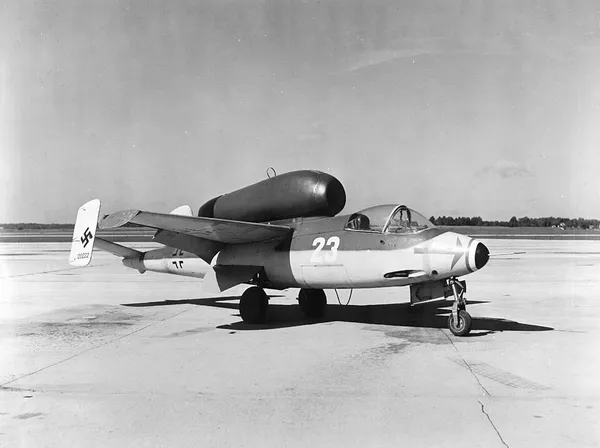
The Heinkel He 162 Volksjäger (German, "People's Fighter") is a German single-engine, jet-powered fighter aircraft used by the Luftwaffe late in World War II. Developed under the Emergency Fighter Program, it was designed and built quickly and made primarily of wood as metals were in very short supply and prioritised for other aircraft. Volksjäger was the Reich Air Ministry's official name for the government design program competition which was won by the He 162 design. Other names include Salamander, which was the codename of its wing-construction program, and Spatz ("Sparrow"), which was the name given to the aircraft by Heinkel. The aircraft was notable for its small size. Although almost the same length as a Messerschmitt Bf 109, its wingspan of 7.2 m (24 ft)was much less than the 9.9 m (32 ft) of the Bf 109. It had a distinctive top-mounted engine which, combined with the aircraft's short landing gear, allowed the engine to be easily accessed for maintenance. This would have made bailing out without hitting the engine difficult, and the He 162 was the first single-engine aircraft provided with an ejection seat. The small size left little room for fuel, which, combined with the inefficient engine, resulted in very limited endurance – around 20 minutes – and it only had room for two autocannons, making it relatively underarmed for the era. Flight testing began on 6 December 1944. A series of fatal accidents during testing required a series of refinements which delayed the program. Although production lines were set up and deliveries began in early 1945, the impending defeat of Germany by that time made the effort pointless. Of nearly 1,000 aircraft on the assembly lines, only about 120 were delivered and most of those never flew, usually due to shortages of parts, fuel, and pilots. A few were used in development squadrons and these ultimately saw combat in a few cases during April 1945, yet the He 162 also proved to be quite dangerous to its own pilots as its small fuel load led to a number of aircraft crashing off field, while additional losses were attributed to structural failure. Production was still underway when the war ended in May 1945. Numerous examples were captured by the Allied forces along with ample supplies of parts from the production lines. The leading British test pilot of the era, Eric Brown, flew a He 162 soon after the war's end.
Also on this shelf
Claude-Henri Belgrand de Vaubois.
Grenade.
See also
Uncatalogued shelfText from Wikipedia; plate via Wikimedia Commons. Text CC BY-SA 4.0; plate freely licensed (see Commons). Source record. Images and catalogue data are reproduced from open-access collections.