Arms and Armour
Dane axe
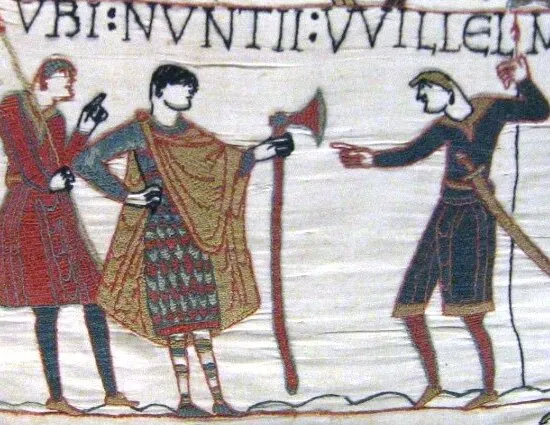
The Dane axe or long axe (including Danish axe and English long axe) is a type of European early medieval period two-handed battle axe with a very long shaft, around 0.9–1.2 metres (2 ft 11 in – 3 ft 11 in) at the low end to 1.5–1.7 metres (4 ft 11 in – 5 ft 7 in) or more at the long end. Sometimes called a broadaxe (Old Norse: breiðøx), the blade was broad and thin, intended to give a long powerful cut when swung, effective against cavalry, shields and unarmored opponents. Dane axes were predominantly used during the European Viking Age to the transition between the Early Middle Ages and High Middle Ages, later being developed into the poleaxe, halberd and other similar polearms by lengthening the shaft and adding a lengthwise pike on the end and spike on the reverse. It is one of the predominant weapons depicted on the Bayeux Tapestry, a period tapestry depicting the events of the Norman Conquest of England in 1066, and one of the specified weapons common with the Varangian Guard.
Also on this shelf
Crossbow.
Château de Druyes.
See also
Uncatalogued shelfText from Wikipedia; plate via Wikimedia Commons. Text CC BY-SA 4.0; plate freely licensed (see Commons). Source record. Images and catalogue data are reproduced from open-access collections.