Arms and Armour
Ludlow Castle
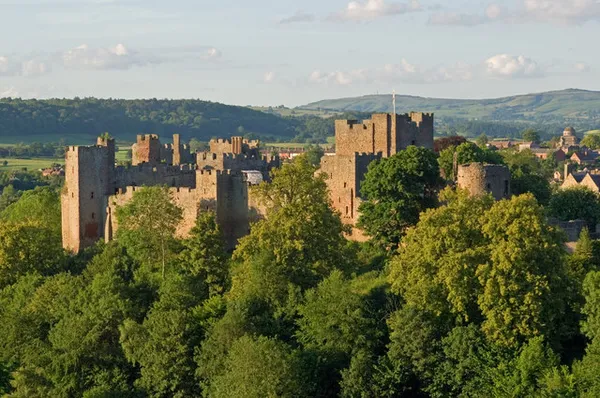
Ludlow Castle is a ruined medieval fortification in the town of Ludlow in the English county of Shropshire, standing on a promontory overlooking the River Teme. The castle was probably founded by Walter de Lacy after the Norman Conquest and was one of the first stone castles to be built in England. During the The Anarchy a civil war of the 12th century, the castle changed hands several times between the de Lacys and rival claimants and was further fortified with a Great Tower and a large outer bailey. In the mid-13th century, Ludlow was passed on to Geoffrey de Geneville, who rebuilt part of the inner bailey, and the castle played a part in the Second Barons' War. Roger Mortimer acquired the castle in 1301, further extending the internal complex of buildings. Richard, Duke of York, inherited the castle in 1425, and it became a symbol of Yorkist authority during the Wars of the Roses. When Richard's son, Edward IV, seized the throne in 1461 it passed into the ownership of the Crown. Ludlow Castle was chosen as the seat of the Council of Wales and the Marches, acting as the capital of Wales and it was extensively renovated in the 16th century. By the 17th century the castle was luxuriously appointed, hosting events such as the first performance of John Milton's masque Comus. Ludlow Castle was held by the Royalists during the English Civil War of the 1640s, until it was besieged and taken by a Parliamentarian army in 1646. The contents of the castle were sold off and a garrison was retained there for much of the interregnum. With the Restoration of 1660, the council was re-established and the castle repaired, but Ludlow never recovered from the civil war years and when the council was abolished in 1689 it fell into neglect. Henry, 1st Earl of Powis, leased the property from the Crown in 1772, extensively landscaping the ruins, while his brother-in-law, Edward, 1st Earl of Powis (by the third creation of the Earldom of Powis), bought the castle outright in 1811. A mansion was constructed in the outer bailey but the remainder of the castle was left largely untouched, attracting an increasing number of visitors and becoming a popular location for artists. After 1900, Ludlow Castle was cleared of vegetation and over the century it was extensively repaired by the Powis Estate and government bodies.
Also on this shelf
Hillside castle.
Inch Castle.
See also
Uncatalogued shelfText from Wikipedia; plate via Wikimedia Commons. Text CC BY-SA 4.0; plate freely licensed (see Commons). Source record. Images and catalogue data are reproduced from open-access collections.