Arms and Armour
John Brown's raid on Harpers Ferry
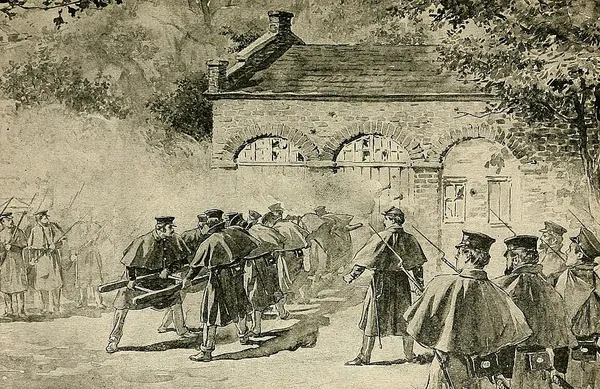
From October 16 to 18, 1859, American abolitionist John Brown attempted to initiate a slave revolt in Southern states by raiding an armory in Harpers Ferry, Virginia (now West Virginia). The raid is frequently cited as one of the primary causes of the American Civil War. Brown's party of 22 was defeated by a platoon of U.S. Marines, led by First Lieutenant Israel Greene. Ten of the raiders were killed during the raid, seven were tried and executed afterwards, and five escaped. Several of those present at the raid would later be prominent figures in the Civil War: Colonel Robert E. Lee was in overall command of the operation to retake the arsenal. Stonewall Jackson and Jeb Stuart were among the troops guarding the arrested Brown, and John Wilkes Booth was a spectator at Brown's execution. John Brown had originally asked Harriet Tubman and Frederick Douglass, both of whom he had met in his transformative years as an abolitionist in Springfield, Massachusetts, to join him in his raid, but Tubman was prevented by illness and Douglass declined, as he believed Brown's plan was suicidal. The raid was extensively covered in the press nationwide—it was the first such national crisis to be publicized using the new electrical telegraph. Reporters were on the first train leaving for Harpers Ferry after news of the raid was received, at 4 p.m. on Monday, October 17. It carried Maryland militia, and parked on the Maryland side of the Harpers Ferry bridge, just 3 miles (4.8 km) east of the town (at the hamlet of Sandy Hook, Maryland). As there were few official messages to send or receive, the telegraph itself was carried on the next train, connected to the telegraph wires that had been cut at the start of the raid, and was "given up to reporters" who "are in force strong as military". By Tuesday morning the telegraph line had been repaired, and there were reporters from The New York Times "and other distant papers". Brown's raid caused much excitement and anxiety throughout the United States, with the South seeing it as a threat to slavery and thus their way of life, and some in the North perceiving it as a bold abolitionist action. At first it was generally viewed as madness, the work of a fanatic. It was Brown's words and letters after the raid and at his trial – Virginia v.
Also on this shelf
Fortifications of Mdina.
Cité de Carcassonne.
See also
Uncatalogued shelfText from Wikipedia; plate via Wikimedia Commons. Text CC BY-SA 4.0; plate freely licensed (see Commons). Source record. Images and catalogue data are reproduced from open-access collections.