Arms and Armour
Dunkirk evacuation
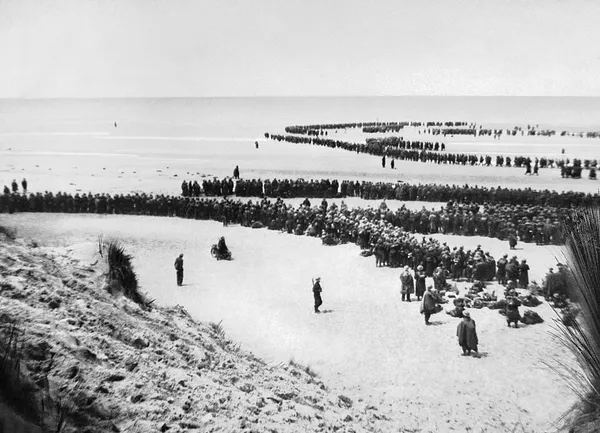
In the Dunkirk evacuation, codenamed Operation Dynamo and also known as the Miracle of Dunkirk, or just Dunkirk, more than 338,000 Allied soldiers were evacuated during the Second World War from the beaches and harbour of Dunkirk in northern France between 26 May and 4 June 1940. The operation began after large numbers of Belgian, British, and French troops (as well as smaller contingents of Dutch and Polish soldiers) were cut off and surrounded by German troops during the six-week Battle of France. After Germany invaded Poland in September 1939, France and the British Empire declared war on Germany and imposed an economic blockade. The British Expeditionary Force (BEF) was sent to help defend France. After the Phoney War of October 1939 to April 1940, Germany invaded Belgium, the Netherlands, and France on 10 May 1940. Three panzer corps attacked through the Ardennes and drove northwest to the English Channel. By 21 May, German forces had trapped the BEF, the remains of the Belgian forces, and three French field armies along the northern coast of France. BEF commander General Viscount Gort immediately saw evacuation across the Channel as the best course of action, and began planning a withdrawal to Dunkirk, the closest good port. Late on 23 May, the halt order was issued by Generaloberst Gerd von Rundstedt, commander of Army Group A. Adolf Hitler approved this order the next day, and had the German High Command send confirmation to the front. Attacking the trapped BEF, French, and Belgian armies was left to the Luftwaffe until the order was rescinded on 26 May. This gave Allied forces time to construct defensive works and pull back large numbers of troops to fight the Battle of Dunkirk. From 28 to 31 May, in the siege of Lille, the remaining 40,000 men of the French First Army fought a delaying action against seven German divisions, including three armoured divisions. On the first day, only 7,669 Allied soldiers were evacuated, but by the end of the eighth day, 338,226 had been rescued by a hastily assembled fleet of over 800 vessels. Many troops were able to embark from the harbour's protective mole onto 39 British Royal Navy destroyers, four Royal Canadian Navy destroyers, at least three French Navy destroyers, and a variety of civilian merchant ships. Others had to wade out from the beaches, waiting for hours in shoulder-deep water.
Also on this shelf
Convoy PQ 14.
Gocha Laghidze.
See also
Uncatalogued shelfText from Wikipedia; plate via Wikimedia Commons. Text CC BY-SA 4.0; plate freely licensed (see Commons). Source record. Images and catalogue data are reproduced from open-access collections.