Arms and Armour
Hoplite
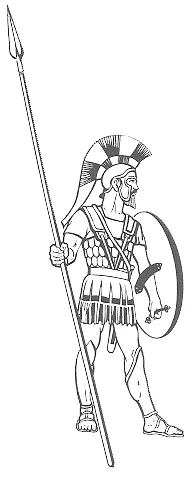
Hoplites ( HOP-lytes; Ancient Greek: ὁπλῖται, romanised: hoplîtai [hoplîːtai̯]) were citizen-soldiers of Ancient Greek city-states who were primarily armed with spears and shields. Hoplite soldiers used the phalanx formation to be effective in war with fewer soldiers. The formation discouraged the soldiers from acting alone, for this would compromise the formation and minimise its strengths. Hoplites were primarily free citizens – propertied farmers and artisans – who were able to afford a linen or bronze armour suit and weapons (estimated at a third to a half of its able-bodied adult male population). Some states maintained a small elite professional unit, known as the epilektoi or logades ('the chosen') because they were picked from the regular citizen infantry. These existed at times in Athens, Sparta, Argos, Thebes, and Syracuse, among other places. Hoplite soldiers made up the bulk of ancient Greek armies. In the 8th century BC, Greek armies started to adopt the phalanx formation. The formation proved successful in defeating the Persians when employed by the Athenians at the Battle of Marathon in 490 BC during the First Greco-Persian War. The Persian archers and light troops who fought in the Battle of Marathon failed because their bows were too weak for their arrows to penetrate the wall of Greek shields of the phalanx formation. The phalanx was also employed by the Greeks at the Battle of Thermopylae in 480 BC and at the Battle of Plataea in 479 BC during the Second Greco-Persian War. The word hoplite (Greek: ὁπλίτης hoplítēs; pl. ὁπλῖται hoplĩtai) derives from hoplon (ὅπλον : hóplon; plural hópla ὅπλα), referring to the hoplite's equipment. In the modern Hellenic Army, the word hoplite (Greek: oπλίτης : oplítîs) is used to refer to an infantryman.
Also on this shelf
Charles I's journey from Oxford to the Scottish army camp near Newark.
Château de Lichtenberg.
See also
Uncatalogued shelfText from Wikipedia; plate via Wikimedia Commons. Text CC BY-SA 4.0; plate freely licensed (see Commons). Source record. Images and catalogue data are reproduced from open-access collections.