Arms and Armour
Greek War of Independence
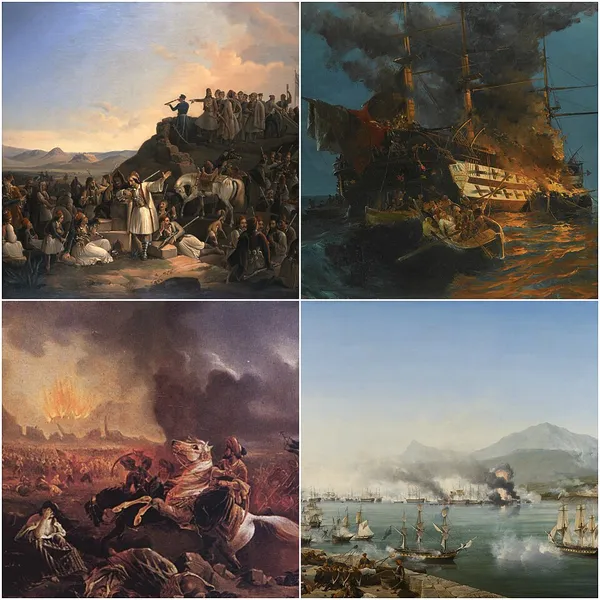
The Greek War of Independence, also known as the Greek Revolution or the Greek Revolution of 1821, was a successful war of independence fought by Greek revolutionaries against the Ottoman Empire from 1821 to 1829. In 1826, the Greeks were assisted by the British Empire, the Kingdom of France, and the Russian Empire, while the Ottomans were aided by their vassals, especially by the Eyalet of Egypt. The war led to the formation of modern Greece, which in subsequent years would be expanded to its current size. The revolution is commemorated by Greeks in Greece and the Greek diaspora on 25 March, as Independence Day. All Greek territory, except the Ionian Islands, came under Ottoman rule in the 15th century, in the decades surrounding the Fall of Constantinople. During the following centuries, there were sporadic but unsuccessful Greek uprisings against Ottoman rule. In 1814, a secret organization called the Filiki Eteria (Society of Friends) was founded by Nikolaos Skoufas, Emmanuil Xanthos, and Athanasios Tsakalov with the aim of liberating Greece. It planned to launch revolts in the Peloponnese, the Danubian Principalities, and Constantinople. The insurrection was planned for 25 March 1821, the Orthodox Christian Feast of the Annunciation. However, the plans were discovered by the Ottoman authorities, forcing it to start earlier. The first revolt began on 21 February 1821 in the Danubian Principalities, but it was soon put down by the Ottomans. These events urged Greeks in the Peloponnese into action and on 17 March 1821, the Maniots were first to declare war. In September 1821, the Greeks, under the leadership of Theodoros Kolokotronis, captured Tripolitsa. Revolts in Crete, Macedonia, and Central Greece broke out, but were suppressed. Greek fleets achieved success against the Ottoman navy in the Aegean Sea and prevented Ottoman reinforcements from arriving by sea. Tensions developed among Greek factions, leading to two consecutive civil wars. The Ottoman Sultan called in Muhammad Ali of Egypt, who agreed to send his son, Ibrahim Pasha, to Greece with an army to suppress the revolt in return for territorial gains. Ibrahim landed in the Peloponnese in February 1825 and brought most of the peninsula under Egyptian control by the end of that year.
Also on this shelf
140th (5th London) Field Regiment, Royal Artillery.
Concentric castle.
See also
- ▸Bolesław II the Bold's expedition to Kiev (1069–1071)
- ▸Carolingian illumination
- ▸Castle of Smar Jbeil
Text from Wikipedia; plate via Wikimedia Commons. Text CC BY-SA 4.0; plate freely licensed (see Commons). Source record. Images and catalogue data are reproduced from open-access collections.