Arms and Armour
Eastern Front (World War II)
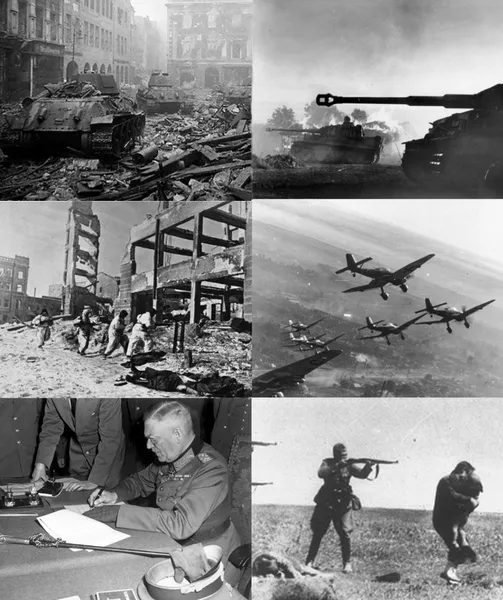
The Eastern Front, also known as the Great Patriotic War, or the German–Soviet War, was a theatre of World War II fought between the European Axis powers and Allies, including the Soviet Union (USSR) and Poland. It encompassed Central Europe, Eastern Europe, Northeast Europe (Baltics), and Southeast Europe (Balkans), and lasted from 22 June 1941 to 9 May 1945. Of the estimated 70–85 million deaths attributed to the war, around 30 million occurred on the Eastern Front, including 9 million children. The Eastern Front was decisive in determining the outcome in the European theatre of operations in World War II and is the main cause of the defeat of Nazi Germany and the Axis nations. Historian Geoffrey Roberts noted that "more than 80 percent of all combat during the Second World War took place on the Eastern Front". The Axis forces, led by Germany, invaded the Soviet Union in Operation Barbarossa on 22 June 1941. Despite warnings and the deployment of Axis armies on his borders, Stalin refused to believe that Hitler would invade and forbade any defensive preparations as to not provoke possible German retaliation. Thus, the Soviets were caught completely unprepared. They were unable to halt deep Axis advances into Russia, which came close to seizing Moscow. However, the Axis offensive stalled and failed to capture the city, and Hitler shifted his focus to the oil fields of the Caucasus the following year. German forces advanced into the Caucasus under Fall Blau ("Case Blue"), launched on 28 June 1942. The Soviets decisively defeated the Axis at the Battle of Stalingrad—the bloodiest battle in the war and arguably in all of human history—making it one of the key turning points of the front. A second great Axis defeat, at the Battle of Kursk, crippled German offensive capabilities permanently and cleared the way for Soviet offensives. Following the Red Army's enormous success in Operation Bagration, when they destroyed Germany's Army Group Center, several Axis allies defected to the Communists, such as Romania and Bulgaria. The Eastern Front concluded with the capture of Berlin, followed by the signing of the German Instrument of Surrender on 8 May, ending the Eastern Front and the war in Europe. The battles on the Eastern Front constituted the largest military confrontation in history.
Also on this shelf
Carcassonne.
First Bulgarian Empire.
See also
Uncatalogued shelfText from Wikipedia; plate via Wikimedia Commons. Text CC BY-SA 4.0; plate freely licensed (see Commons). Source record. Images and catalogue data are reproduced from open-access collections.