Arms and Armour
Daher al-Umar
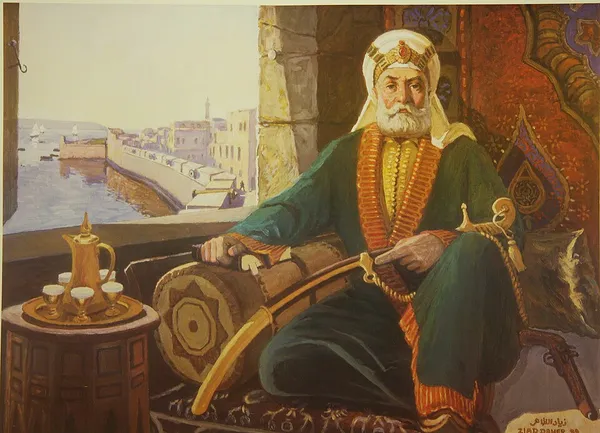
Daher al-Umar al-Zaydani, alternatively spelled Zahir al-Umar or Dahir al-Umar (Arabic: ظاهر العمر الزيداني, romanized: Ẓāhir al-ʿUmar az-Zaydānī, 1689/90 – 21 or 22 August 1775), was the paramount sheikh of the Zayadina family and ruler of northern Palestine from the 1730s until his death in 1775, during Ottoman rule. At his zenith in 1774, he controlled the Syrian coast from Jaffa to Sidon, though formal recognition of his status was limited to that of a multazim (tax farmer). In 1730, Daher took over Tiberias and by c. 1740, Safed and Nazareth. He and his family fortified these towns and other Galilee villages, most notably Deir Hanna, helping them withstand sieges by the governor of Damascus, Sulayman Pasha al-Azm, in 1742–1743. By then, Daher controlled the area's cotton and eventually monopolized its lucratize trade with the French. In 1750, he made the outlet of this trade, the port of Acre, into his capital, developing it into Syria's third largest city. He expanded into Haifa and its environs in the 1760s. His territorial expansion provoked a war with the governor of Damascus, Uthman Pasha al-Kurji, against whom Daher allied with Egypt's mamluk ruler, Ali Bey, and the Shias of southern Lebanon. Their military campaigns ousted Uthman Pasha and his son from Damascus and Sidon, culminating with Daher's victory at Lake Hula and occupations of Jaffa and Sidon in 1771. By 1774, the Ottoman army chief in Syria recognized his control of Sidon province and most of Palestine, but this was soon rescinded by the new sultan. In March 1775, Abu al-Dhahab, who had earlier toppled Ali Bey, ousted Daher from Acre, but died soon after and Daher returned to power. In August, the Ottomans, freed up from their six-year war with Russia, blockaded Acre and eliminated Daher. The last of the Zayadina were neutralized in 1776 by Acre's new governor, Ahmad Pasha al-Jazzar. Daher's establishment of law and order, flexible taxation policies, and battlefield reputation earned him the goodwill of the local peasantry. He invited Christian and Jewish immigrants from across the empire, stimulating the economy and leading to the significant growth of the Christian communities in Acre and Nazareth and the Jewish community in Tiberias. Under his rule, northern Palestine's main centers, Acre, Haifa, Tiberias, and Nazareth, urbanized and prospered after long periods of decline.
Also on this shelf
Campo Maior, Portugal.
Copenhagen.
See also
Uncatalogued shelfText from Wikipedia; plate via Wikimedia Commons. Text CC BY-SA 4.0; plate freely licensed (see Commons). Source record. Images and catalogue data are reproduced from open-access collections.