Arms and Armour
Action of the Cockcroft
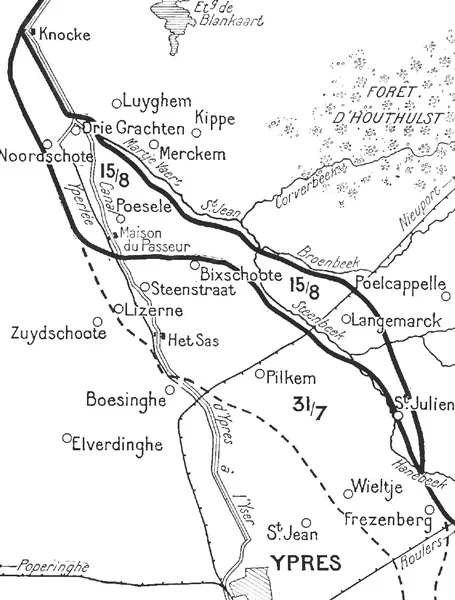
The action of the Cockcroft took place on 19 August 1917, during the Third Battle of Ypres on the Western Front in the First World War. At the Battle of Langemarck (16–18 August 1917) an attack on the German 4th Army by the British Fifth Army, the infantry of the 48th (South Midland) Division and the 11th (Northern) Division of XVIII Corps had been stopped well short of their objectives. The British had been shot down by the German garrisons of blockhouses and pillbox outposts of the Wilhelmstellung (the third German defensive position). At a conference called by General Hubert Gough, the Fifth Army commander, on 17 August, Gough and the corps commanders arranged for local attacks to be made at various points, to reach a good jumping-off line for another general attack on 25 August. The commanders of XIX Corps and XVIII Corps were ordered to arrange advances to within about 200 yd (180 m) of the Wilhelmstellung, to come into line with the XIV Corps on the left flank; II Corps, further south, was to capture Inverness Copse on 22 August. At 4:45 a.m. on 19 August, five tanks of the 1st Tank Brigade broke down or ditched; seven others advanced up the St Julian–Poelcappelle road behind a smoke barrage, their noise smothered by low-flying British aircraft. The tanks were followed by parties of the 1/8th Battalion, Royal Warwickshire Regiment, ready to occupy the strong points and pillboxes as their garrisons were overcome by the tanks. At most of the pillboxes, the German occupants retreated as soon as they saw the tanks; at the Cockcroft, Triangle Farm and Maison du Hibou the garrisons stood their ground, suffering about 100 casualties and thirty men taken prisoner. Two of the tanks were knocked out and two crew were killed along with 13 to 14 wounded; fifteen Royal Warwicks were also wounded. In 1996, Prior and Wilson wrote that the method was hard to repeat and created unrealistic expectations of the tanks. In 2017, Nick Lloyd wrote that the attack had been "a remarkable exercise in ingenuity and imagination" which raised Tank Corps morale.
Also on this shelf
History of Transylvania.
Danish War Museum.
See also
Uncatalogued shelfText from Wikipedia; plate via Wikimedia Commons. Text CC BY-SA 4.0; plate freely licensed (see Commons). Source record. Images and catalogue data are reproduced from open-access collections.