Arms and Armour
Disappearing gun
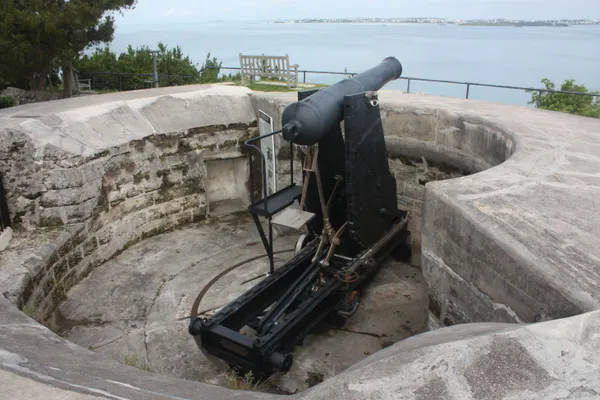
A disappearing gun, which is a gun mounted on a disappearing carriage, is an obsolete type of artillery which enabled a gun to be hidden from direct fire and observation. The overwhelming majority of such carriage designs enabled the gun to retract backwards and down after it was fired, thus placing it behind a parapet or into a pit protected by a wall. A small number were simply barbette mounts on a retractable platform. Either way, retraction lowered the gun from view and protected it from direct fire by the enemy while it was being reloaded. This design also made reloading easier, since it lowered the breech to a level just above the loading platform; shells could be rolled right up to the open breech for loading and ramming. Other benefits over non-disappearing types were a higher rate of repetitive fire and less fatigue for the gun crew. Some disappearing carriages were complicated mechanisms, protection from aircraft observation and attack was difficult, and almost all restricted the elevation of the gun. With a few exceptions, construction of new disappearing gun installations ceased by 1918. The last new disappearing gun installation was a solo 16-inch gun M1919 at Fort Michie on Great Gull Island, New York, completed in 1923. In the U.S., due to lack of funding for sufficient replacements, the disappearing gun remained the most numerous type of coast defense weapon until replaced by improved weapons in World War II. Although some early designs were intended as field siege guns, over time the design became associated with fixed fortifications, most of which were coastal artillery. A late exception was the use in mountain fortifications in Switzerland, where six 120 mm guns on rail-mounted Saint Chamond disappearing carriages remained at Fort de Dailly until replaced in 1940. The disappearing gun was usually moved down behind the parapet or into its protective housing by the force of its own recoil, but some also used compressed air while a few were built to be raised by steam.
Also on this shelf
Battle of Tukaroi.
Caerphilly Castle.
See also
Uncatalogued shelfText from Wikipedia; plate via Wikimedia Commons. Text CC BY-SA 4.0; plate freely licensed (see Commons). Source record. Images and catalogue data are reproduced from open-access collections.