Arms and Armour
Bangalore Fort
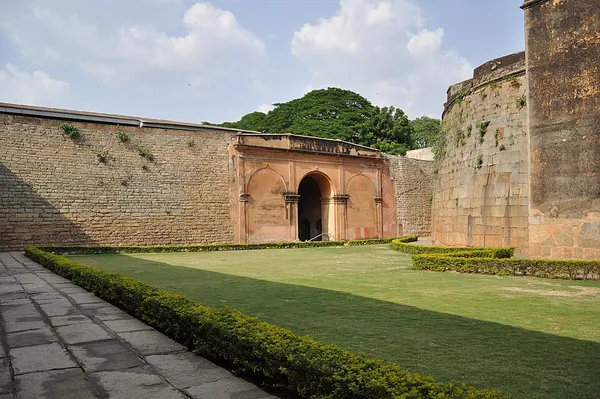
Bangalore Fort began construction in 1537 as a mud fort. The builder was Kempe Gowda I, a vassal of the Vijayanagara Empire and the founder of Bangalore. The then Sultan of Mysore Hyder Ali in 1761 replaced the mud fort with a stone fort and it was further improved by his son, Tipu Sultan in the late 18th century. Though damaged during the Anglo-Mysore war in 1791, it still remains a good example of 18th-century military fortification. The army of the British East India Company, led by Lord Cornwallis on 21 March 1791 captured the fort in the Siege of Bangalore during the Third Mysore War (1790–1792). At the time the fort was a stronghold for Tipu Sultan. Today, the fort's Delhi gate, on Krishnarajendra Road, and two bastions are the primary remains of the fort. A marble plaque commemorates the spot where the British breached the fort's wall, leading to its capture. The old fort area also includes Tipu Sultan's Summer Palace, and his armoury. The fort provided the setting for the treasure hunt in the book Riddle of the Seventh Stone.
Also on this shelf
History of weapons.
Covertway.
See also
Uncatalogued shelfText from Wikipedia; plate via Wikimedia Commons. Text CC BY-SA 4.0; plate freely licensed (see Commons). Source record. Images and catalogue data are reproduced from open-access collections.