Arms and Armour
Early Muslim conquests
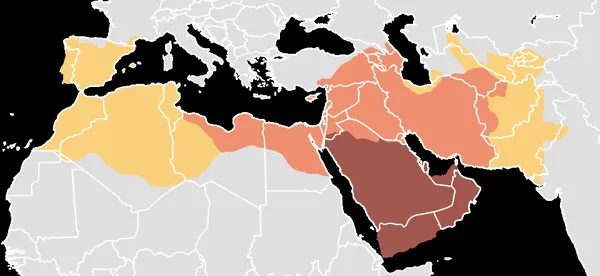
The early Muslim conquests, or the early Islamic conquests (Arabic: الْفُتُوحَاتُ الإسْلَامِيَّة, romanized: al-Futūḥāt al-ʾIslāmiyya), also known as the Arab conquests, were a series of wars initiated by the Islamic prophet Muhammad, and continued by the early Muslims. In 622, he established the first Islamic state in Medina, with Muslim armies expanding rapidly out of Arabia under the succeeding Rashidun Caliphate and then the Umayyad Caliphate, culminating in Muslim rule being established throughout most of the Middle East and North Africa, parts of South Asia and Central Asia, and parts of Southern Europe over the following century. According to the Scottish historian James Buchan: "In speed and extent, the first Arab conquests were matched only by those of Alexander the Great, and they were more lasting." At the height of the expansion, Muslim-ruled territory under the Caliphates is estimated to have covered 13,000,000 square kilometres (5,000,000 sq mi), stretching from the Indian subcontinent (at Sind) in the east to the Iberian Peninsula (up to Septimania) in the west. Among other socio-political changes, the early Muslim conquests caused a rupture in the status quo dominated by the Sasanian Empire in the east and the Byzantine Empire in the west; Muslim armies overran the Sasanians and confined the Byzantines, who were left with part of Anatolia and Southeastern Europe. Detailed explanations for the success of the Muslim campaigns have been difficult to discover, largely because only fragmentary sources have survived from the period. American scholar Fred Donner suggests that Muhammad's establishment of the first Islamic state coupled with ideological coherence and mobilization constituted the main factor that propelled his community to successfully establish one of the largest empires in history. Most historians also agree that, as another primary factor that favoured the Muslim war effort, the Sasanians and the Byzantines were rendered militarily and economically exhausted from decades of warfare against each other, with the Sasanian civil war of 628–632 further accelerating political collapse. It is also believed that Jews and some Christians in both Sasanian and Byzantine territory may have been dissatisfied with the state of the two empires and either welcomed or were indifferent to the invading Muslim troops.
Also on this shelf
Battle of Meung-sur-Loire.
110th Light Anti-Aircraft Regiment, Royal Artillery.
See also
Uncatalogued shelfText from Wikipedia; plate via Wikimedia Commons. Text CC BY-SA 4.0; plate freely licensed (see Commons). Source record. Images and catalogue data are reproduced from open-access collections.