Arms and Armour
Battle of the Ruhr
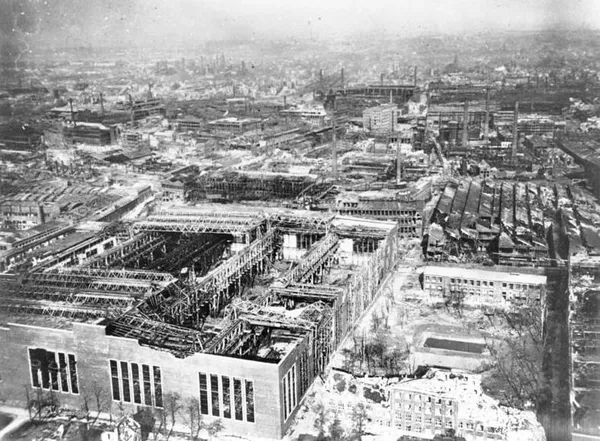
The Battle of the Ruhr (5 March – 31 July 1943) was a strategic bombing campaign against the Ruhr Area in Nazi Germany carried out by RAF Bomber Command during the Second World War. The Ruhr was the main centre of German heavy industry with coke plants, steelworks, armaments factories and ten synthetic oil plants. The British attacked 26 targets identified in the Combined Bomber Offensive. Targets included the Krupp armament works (Essen), the Nordstern synthetic oil plant at Gelsenkirchen and the Rheinmetall–Borsig plant in Düsseldorf, which was evacuated during the battle. The battle included cities such as Cologne not in the Ruhr proper but which were in the larger Rhine-Ruhr region and considered part of the Ruhr industrial complex. Some targets were not sites of heavy industry but part of the production and movement of materiel. The Ruhr had been attacked by Bomber Command from 1940; its defences and the amounts of industrial pollutants produced a semi-permanent smog that hampered bomb aiming. Along with anti-aircraft guns, searchlights and night fighters, the Germans built large decoys such as the Krupp decoy site (Kruppsche Nachtscheinanlage) near Essen to spoof the bombers into hitting open country. Cities outside the Ruhr were attacked to prevent the Germans from concentrating their defences and before the end of the battle, Operation Gomorrah on 24 July 1943, began the Battle of Hamburg. After the turn to Hamburg, Bomber Command continued to raid the Ruhr to keep the German defences dispersed.
Also on this shelf
Honda Tadakatsu.
Ksani fortress.
See also
Uncatalogued shelfText from Wikipedia; plate via Wikimedia Commons. Text CC BY-SA 4.0; plate freely licensed (see Commons). Source record. Images and catalogue data are reproduced from open-access collections.