Arms and Armour
Battle of Ginchy
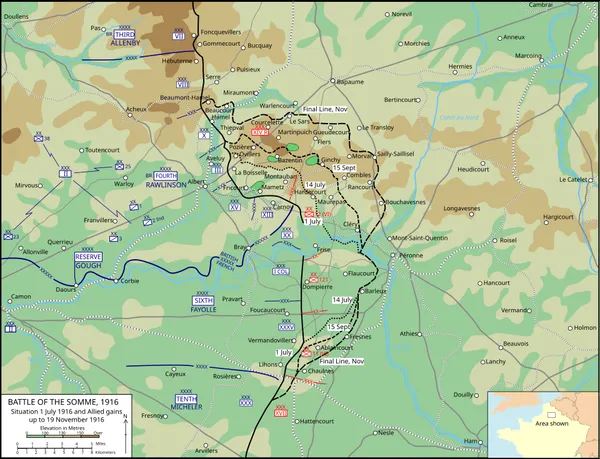
The Battle of Ginchy took place on 9 September 1916 during the Battle of the Somme, when the 16th (Irish) Division captured the German-held village. Ginchy is 0.93 mi (1.5 km) north-east of Guillemont, at the junction of six roads, on a rise overlooking Combles, 2.5 mi (4 km) to the south-east. After the conclusion of the Battle of Guillemont on 6 September, XIV Corps and XV Corps were required to complete the advance to positions which would give observation over the German third position. The advance was to make ready for a general attack in mid-September, for which the Anglo-French armies had been preparing since early August. British attacks northwards from the boundary between the Fourth Army and the French Sixth Army, from Leuze Wood north to Ginchy, had begun on 3 September when the 7th Division captured the village, then was forced out by a German counter-attack. Attacks on Leuze Wood and attempts to re-take Ginchy on 4 and 5 September were also defeated by German counter-attacks. The 7th Division was relieved by the 16th (Irish) Division and 55th (West Lancashire) Division on the evening of 7 September and the 5th Division was replaced by the 56th (1/1st London) Division on the right at the boundary with the French. On 9 September the British began a bombardment early in the morning but waited until late afternoon to advance, to deny the Germans time to counter-attack before dark. The British assault in the south by the 56th (1/1st London) Division and the 16th (Irish) Division reached Bouleaux Wood but the attack in the centre was repulsed. On the northern flank, Ginchy was captured by the 16th (Irish) Division and several German counter-attacks were defeated. The loss of Ginchy deprived the Germans of observation posts from which they could observe the battlefield. The success eliminated the salient at Delville Wood, which had been costly to defend, due to observed German artillery-fire from three sides and the many counter-attacks by German infantry in July and August; the attack on 31 August, being the largest mounted by the Germans against the British during the battle. The success of the attack by the French Sixth Army on 12 September, its biggest operation of the battle and the advance of the right flank of the British Fourth Army from 3 to 9 September, enabled both armies to make much bigger attacks.
Also on this shelf
Battle of the Olive Grove of Kountouras.
BM-14.
See also
Uncatalogued shelfText from Wikipedia; plate via Wikimedia Commons. Text CC BY-SA 4.0; plate freely licensed (see Commons). Source record. Images and catalogue data are reproduced from open-access collections.