Arms and Armour
Casemate
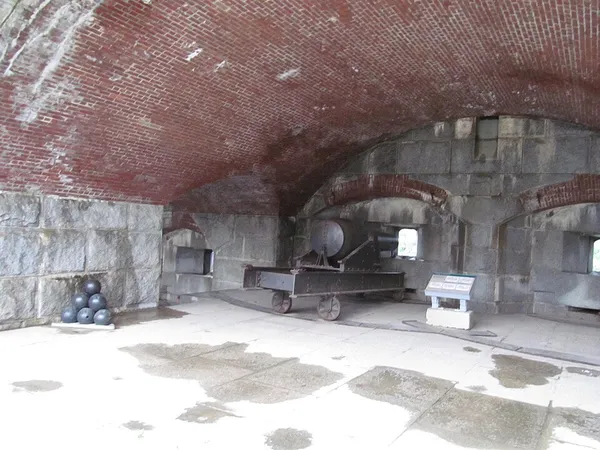
A casemate is a fortified gun emplacement or armoured structure from which guns are fired, in a fortification, warship, or armoured fighting vehicle. When referring to antiquity, the term "casemate wall" means a double city wall with the space between the walls separated into chambers, which could be filled up to better withstand battering rams in case of siege (see § Antiquity: casemate wall). In its original early modern meaning, the term referred to a vaulted chamber in a fort, which may have been used for storage, accommodation, or artillery that could fire through an opening or embrasure. Although the outward faces of brick or masonry casemates proved vulnerable to advances in artillery performance, the invention of reinforced concrete allowed newer designs to be produced well into the 20th century. With the introduction of ironclad warships, the definition was widened to include a protected space for guns in a ship, either within the hull or in the lower part of the superstructure. Although the main armament of ships quickly began to be mounted in revolving gun turrets, secondary batteries continued to be mounted in casemates; however, several disadvantages eventually led to their replacement by turrets as well. In tanks and other armored fighting vehicles lacking a turret for the main gun, the structure accommodating the gun is also called a casemate.
Also on this shelf
Fortified region of Belfort.
Alexander Suvorov.
See also
Uncatalogued shelfText from Wikipedia; plate via Wikimedia Commons. Text CC BY-SA 4.0; plate freely licensed (see Commons). Source record. Images and catalogue data are reproduced from open-access collections.