Arms and Armour
First Persian invasion of Greece
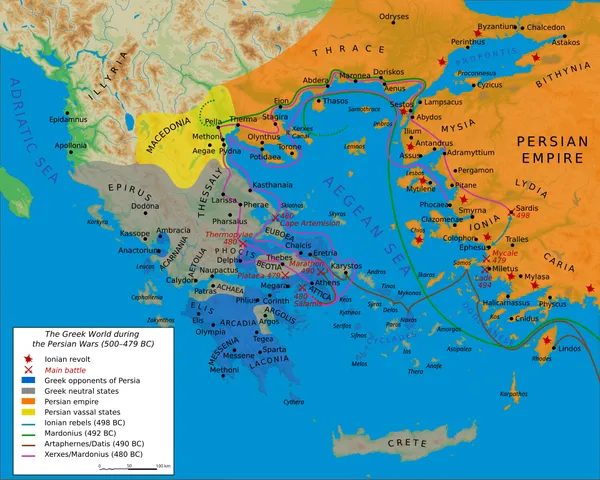
The first Persian invasion of Greece took place from 492 BC to 490 BC, as part of the Greco-Persian Wars. It ended with a decisive Athenian-led victory over the Achaemenid Empire during the Battle of Marathon. Consisting of two distinct campaigns, the invasion of the independent Greek city-states was ordered by the Persian king Darius the Great, who sought to punish Athens and Eretria after they had supported the earlier Ionian Revolt. Additionally, Darius also saw the subjugation of Greece as an opportunity to expand into Southeast Europe and thereby ensure the security of the Achaemenid Empire's western frontier. The first campaign, in 492 BC, was led by the Persian commander Mardonius, who re-subjugated Thrace and forced Macedon to become a fully subordinate client kingdom within the Achaemenid Empire; it had been a Persian vassal as early as the late 6th century BC—probably in 512 BC. However, further progress was prevented when Mardonius' fleet was wrecked in a storm off the coast of Mount Athos. The following year, having demonstrated his intentions, Darius sent envoys to all parts of Greece, demanding their submission. He received it from almost all of them, but not from Athens and Sparta, both of which executed the envoys sent to them. With Athens still defiant, and Sparta now effectively at war with the Persians, Darius ordered a further military campaign for the following year. The second Persian campaign, in 490 BC, was led by the Persian commanders Datis and Artaphernes. The expedition headed first to Naxos, which was captured and burned, and then leapfrogged between the rest of the Cycladic Islands, annexing each of them into the Achaemenid Empire. Reaching Greece, they landed at Eretria, which they besieged, and after a brief time, captured. The Eretrians were enslaved and their city was burned. Finally, the expedition headed to Attica, landing at Marathon, en route to Athens. There, they were met by a smaller Athenian army, which nevertheless proceeded to secure for itself a remarkable victory. This defeat prevented the successful conclusion of the campaign, and the Persian expedition returned to West Asia, though they had fulfilled most of their aims, successfully punishing Naxos and Eretria and bringing much of the Aegean under Persian rule, as well as fully integrating Macedon.
Also on this shelf
Battle of Barcelona (512).
Celtic influences on Tolkien.
See also
Uncatalogued shelfText from Wikipedia; plate via Wikimedia Commons. Text CC BY-SA 4.0; plate freely licensed (see Commons). Source record. Images and catalogue data are reproduced from open-access collections.