Arms and Armour
Battle of Poitiers
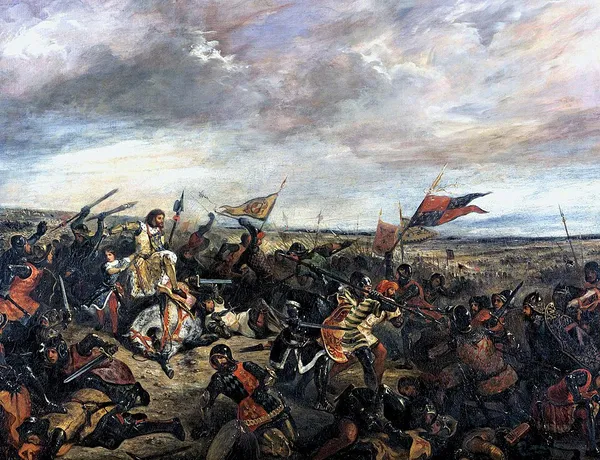
The Battle of Poitiers was fought on 19 September 1356, during the Hundred Years' War, between a French army commanded by King John II and an Anglo-Gascon force under Edward, the Black Prince. It took place in western France, 5 miles (8 km) south of Poitiers, when approximately 14,000 to 16,000 French attacked a strong defensive position held by 6,000 Anglo-Gascons. Nineteen years after the start of the war, Edward, the Black Prince, the eldest son and heir of King Edward III of England, launched a major campaign in south-west France. His army marched from Bergerac to the River Loire, which they were unable to cross. King John II gathered a large and unusually mobile army and pursued Edward's forces. The Anglo-Gascons had by this point established a strong defensive position near Poitiers, and after unsuccessful negotiations between the two sides, were attacked by the French. The first assault included two units of heavily armoured cavalry, a strong force of crossbowmen as well as many infantry and dismounted men-at-arms. They were driven back by the Anglo-Gascons, who were fighting entirely on foot. A second French attack by 4,000 men-at-arms on foot under King John II's son and heir Charles, the dauphin, followed. After a prolonged fight, this too was repulsed. As the Dauphin's division recoiled there was confusion in the French ranks: about half the men of their third division, under Philip, Duke of Orléans, left the field, taking with them all four of John's sons. Some of those who did not withdraw with Philip launched a weak and unsuccessful third assault. The remaining French forces regrouped around the king and launched a fourth attack against the now exhausted Anglo-Gascons, who were still fighting on foot. The French sacred banner, the Oriflamme, borne by Geoffroi de Charny was unfurled, the signal that no prisoners were to be taken. Battle was again joined, with the French slowly getting the better of it. Then a small, mounted, Anglo-Gascon force of 160 men, who had been sent earlier to threaten the French rear, appeared behind the French. Believing themselves surrounded, some Frenchmen fled, which panicked others, and soon the entire French force collapsed. King John II was captured, as were his 14-year-old son Philip and between 2,000 and 3,000 men-at-arms. Approximately 2,500 French men-at-arms were killed.
Also on this shelf
Lorenz rifle.
Bunker.
See also
Uncatalogued shelfText from Wikipedia; plate via Wikimedia Commons. Text CC BY-SA 4.0; plate freely licensed (see Commons). Source record. Images and catalogue data are reproduced from open-access collections.